We're independent: products are chosen on merit and prices come from the retailers' own sites. We may earn a commission if you buy through our links. Learn more.
Key takeaways
- A smokeless fire pit has a double wall that pre-heats air and feeds it in at the top, where it burns off most of the smoke. Less smoke, not no smoke.
- Smokeless pits only work with dry hardwood and a hot, well-fed fire. Wet wood, overloading and the dying embers still smoke.
- A gas fire pit or fire table gives flame with no smoke, sparks or ash, but noticeably less warmth than a wood fire.
- At November 2026 LPG prices (roughly R36–R40 per kg), a gas fire pit with a 7–14 kW burner costs roughly R18–R41 an hour on full flame.
- Both still belong in open air: no wood fire under a roof, and no gas fire pit in an enclosed room or closed-in patio.
Someone wants the crackle and glow after the braai; someone else is tired of smelling like smoke, chasing the wind round the circle, or getting a WhatsApp from the neighbours in the complex. Smokeless fire pits and gas fire pits both promise to end that argument.
They do it in very different ways, and neither is quite what the marketing suggests. This guide explains how a double-wall pit works and when it still smokes, how gas fire pits and fire tables compare, what they cost to run, and which suits a townhouse patio or a bigger garden.
Quick answer
| Smokeless (double-wall) wood pit | Gas fire pit or fire table | Ordinary wood fire pit | |
|---|---|---|---|
| Smoke | Low once it’s hot; some at lighting and the end | None. If you ever smell gas, close the cylinder valve and leak-test before relighting | Plenty, and it follows you |
| Warmth | Good, mostly radiating upward | Low to moderate; more ambience than heat | Best |
| Sparks and ash | Some sparks, little ash | None | Sparks and a lot of ash |
| Fuel | Dry hardwood, sometimes pellets | LPG cylinder (or a fixed gas line) | Wood or charcoal |
| Running cost | Price of a bag of wood | Roughly R18–R41 an hour on full (see below) | Price of a bag of wood |
| Best for | Gardens where smoke is the main complaint | Complexes, covered-but-open patios, instant on/off | Bigger gardens, cooking on the fire |
If smoke is your only problem and you still want a real fire, a double-wall pit is the answer. If sparks, ash or body corporate rules are the problem, go gas. If you want to braai on it, stay with a conventional pit or a proper braai; our fire pit guide covers those.
How a smokeless fire pit works
Smoke is mostly fuel that didn’t finish burning: tiny particles and gases that leave the wood before they get hot enough, with enough oxygen, to burn. A smokeless pit’s job is to give them a second chance.
It does this with two walls and two sets of holes:
- Primary air comes in through holes at the bottom and feeds the fire from underneath, like any good fire basket.
- Air also enters the gap between the two walls. The inner wall gets very hot, so this air heats up as it rises through the gap.
- Secondary air comes out of a ring of holes near the rim, already hot, right where the smoke is rising.
- The smoke reignites. That hot, oxygen-rich air mixes with the smoke and burns much of it off. You often see little jets of flame at the top holes when it’s working. This is the “secondary burn” or “reburn”.
The result is a fire that burns hotter and cleaner, leaves less ash and produces far less smoke once it’s going. It’s the same principle used in many modern closed combustion fireplaces, which also burn their smoke for efficiency (see our closed combustion fireplace guide).
When a smokeless fire pit still smokes
- Wet or green wood, the usual culprit. Damp wood burns cool, so the secondary burn never gets going.
- Overloading. Logs stacked above the top air holes block the secondary air.
- Too little fire. One sad log won’t heat the walls. Build a hot fire first, then feed it steadily.
- Ash build-up choking the bottom holes. Empty it before each fire.
- Pine, pallets and rubbish, which make resinous, sooty smoke no pit can burn off.
Smokeless pit, but less heat around the circle?
Because a double-wall pit is tall-sided and efficient, more of its heat goes straight up and less radiates sideways to your shins. Expect people to sit closer than round an open bowl; some brands sell rim-mounted heat deflectors for this reason.
How a gas fire pit works
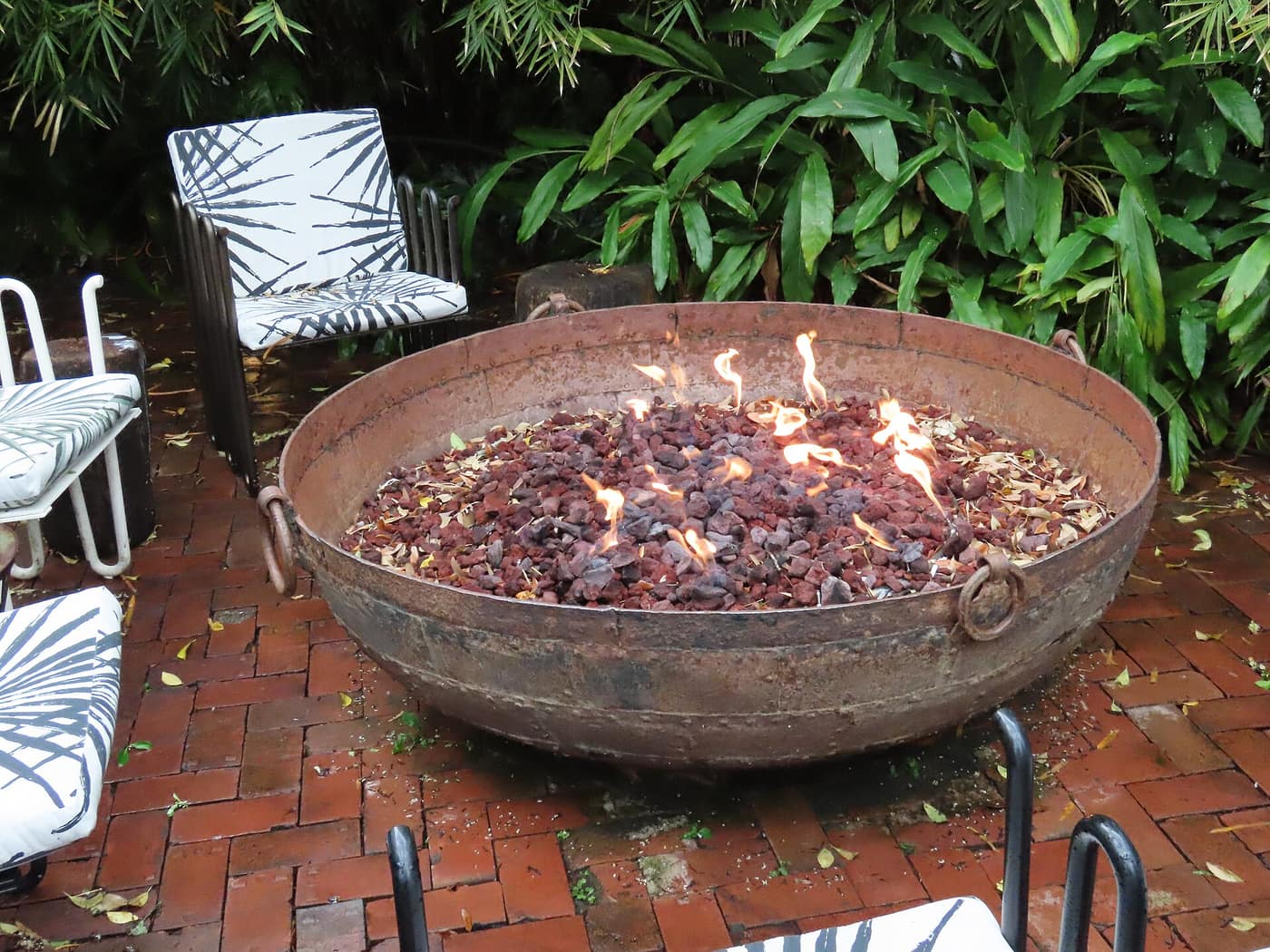
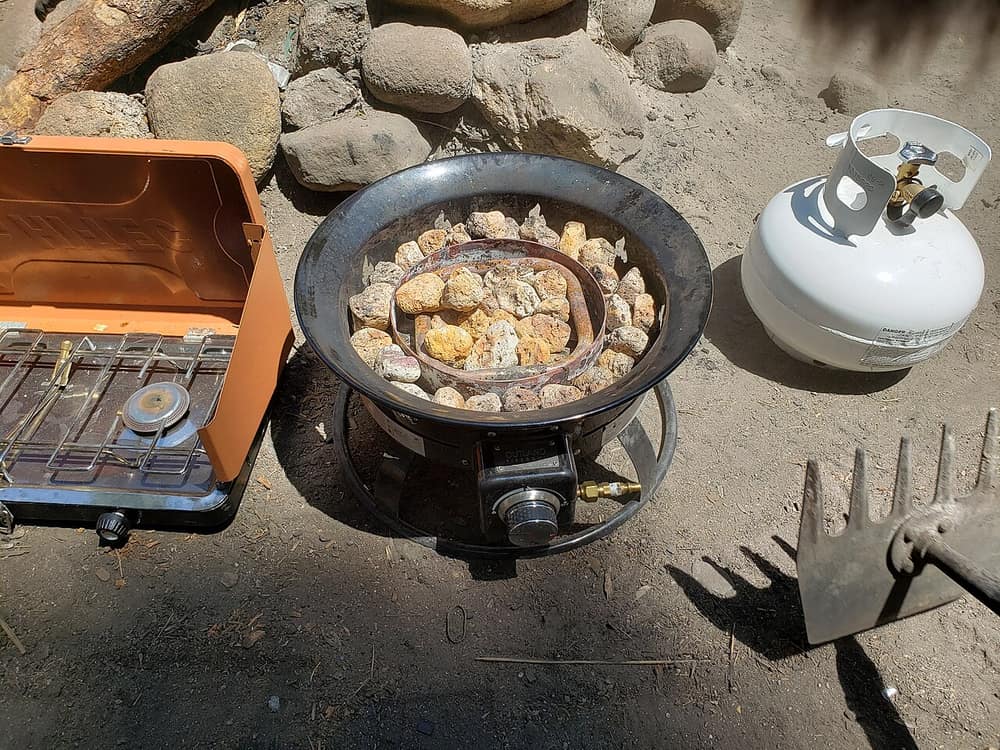
A gas fire pit is simpler. A burner (a ring, a straight “blade” or an H-shape) sits in a bowl or table and is covered with lava rock, fire glass or ceramic logs to spread the flame and hide the metal. Gas comes from an LPG cylinder through a regulator and hose, or from a fixed gas line on a permanent installation. You turn a knob, press an igniter and get flame immediately.
What you get:
- No smoke, no sparks, no ash. This is why gas pits are often the only kind allowed in complexes and estates. Check your conduct rules first.
- Instant on and off. No waiting for wood to catch, and no 45 minutes of dousing and stirring at the end.
- Less warmth. A gas fire pit is mainly about atmosphere. It takes the chill off for the people closest to it; it will not heat a patio the way a mushroom-style patio heater does.
- A cylinder to manage. On most freestanding fire tables the cylinder hides in a ventilated compartment underneath.
Fire table, bowl or built-in?
| Type | What it is | Good for | Watch out for |
|---|---|---|---|
| Gas fire table | Table-height unit with the burner in the middle and the cylinder underneath | Patios and townhouse gardens; doubles as a coffee table with a lid | Small flame area; buy a cover |
| Gas fire bowl | Low bowl with a burner, cylinder alongside or hidden | Gardens where you want the look of a fire bowl without smoke | Hose across the paving is a trip hazard |
| Portable gas fire pit | Small, light unit for a standard cylinder | Camping, caravans, small balconies that allow gas | Low heat; needs a stable, level spot |
| Built-in burner | A burner set into your own boma, pit or table | A permanent feature designed around the space | Building work plus a registered gas installer |
What does a gas fire pit cost to run?
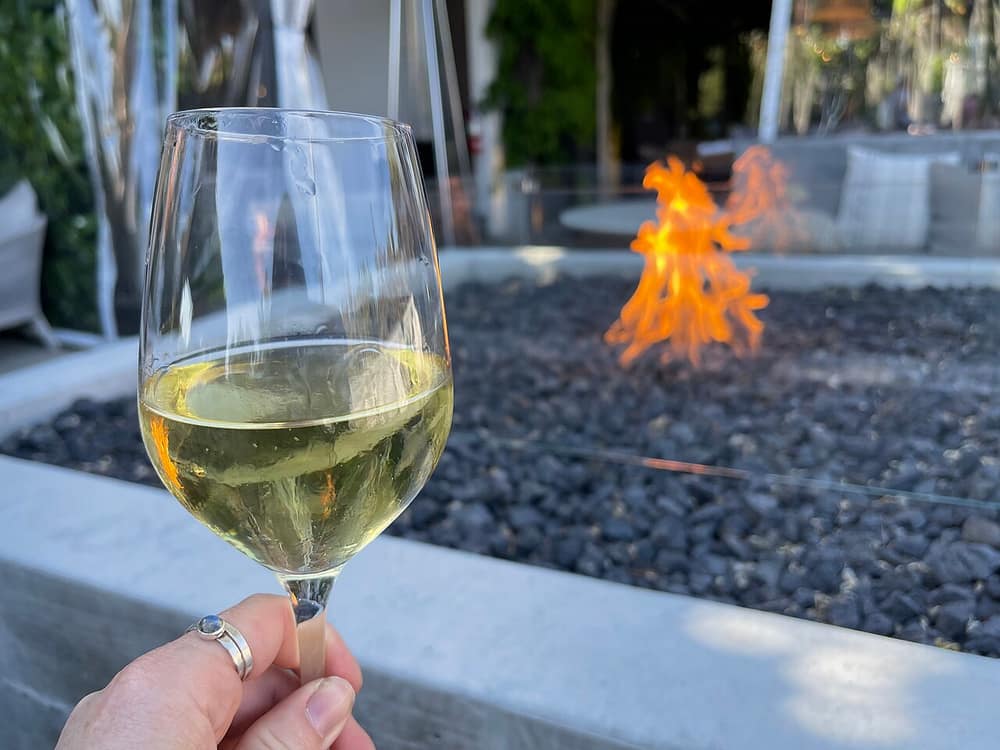
This depends almost entirely on the burner’s rating, so check the kW or MJ/h figure on the label or spec sheet. The maths is straightforward once you have it.
- LPG prices: the government sets maximum retail prices for LPG every month. From 4 November 2026 they were roughly R36 per kg at the coast and about R40 per kg inland, and a refill can cost less than the maximum, so shop around.
- Energy in LPG: one kilogram of LPG holds about 49 MJ, roughly 13.6 kWh. A full 9 kg cylinder holds around 440 MJ.
- Burn rate: a burner rated at 10 kW uses roughly 0.7 kg of gas an hour on full. Turned down, it uses less.
| Burner rating | Gas per hour (full flame) | 9 kg cylinder lasts about | Cost per hour at R36–R40/kg |
|---|---|---|---|
| 7 kW | ~0.5 kg | ~18 hours | ~R18–R21 |
| 10 kW | ~0.7 kg | ~12–13 hours | ~R26–R30 |
| 14 kW | ~1.0 kg | ~9 hours | ~R37–R41 |
These are estimates from the burner rating and November 2026 maximum prices, not measurements. Real use is usually lower, because few people run a fire pit on full all evening, but a winter of weekly fire-pit nights still adds up. If you entertain, keep a spare full cylinder.
Which one for your home?
Townhouse, complex or estate
Read the conduct rules first. Many sectional-title schemes and estates restrict open wood fires because of smoke complaints and fire risk, and some limit gas cylinders too. Where wood fires aren’t allowed, a gas fire table is usually the only realistic option. Where they are allowed but neighbours are close, a double-wall smokeless pit is the considerate choice.
Small garden or covered patio
A gas fire table suits a patio that is covered but open on the sides, as long as the manufacturer allows it and there is plenty of clearance to the roof. A wood pit, smokeless or not, still needs open sky above it: heat and sparks rise.
Bigger garden, farm or smallholding
Here smoke matters less and warmth matters more, so a conventional bowl, a boma or a large smokeless pit makes more sense than gas. If you’re building something permanent, our guide on how to build a boma covers sizes and layouts. On farms, open fires also come with veld fire responsibilities; see veld fires and firebreaks.
Fire pits worth buying
None of the braai and outdoor stores we track had a true double-wall smokeless pit in stock when we checked, so the picks below are a well-ventilated wood boma for less smoke, a freestanding gas fire table, and a built-in gas burner for a permanent feature. Prices were checked in November 2026 and change often.

Alva
Gas Firetable With Lava Rocks & Lid
A gas fire table with lava rocks and a lid, so it works as a side table when the flame is off. A sensible way to get a smoke-free fire onto a townhouse patio without any building work.
- Gas fire table
- Lava rocks included
- Lid doubles as a table top
- No smoke, sparks or ash
- Included lid turns it into a table
- Ambience more than real heat
- Cylinder needs a stable, ventilated spot

Megamaster
Sekel Boma
Megamaster doesn't sell it as a double-wall pit, but it says the 360 ventilation holes give easy lighting and reduced smoke. The budget way to cut smoke while keeping a real wood fire.
- Wood burning
- 360 ventilation holes
- Rust-painted finish
- Poker included
- Real wood fire at a fair price
- Good airflow means faster, cleaner lighting
- Reduces smoke rather than eliminating it

Chad-O-Chef
Chad-O-Chef Firepit Burner (Gas Burning)
A gas fire pit burner from Chad-O-Chef, shown in the store photo set into a built-in fire pit with a log set. Ask the store what is included and whether your set-up needs a fixed gas installation.
- Gas burning
- Fire pit burner
- Gas flame as a permanent feature
- No smoke, sparks or ash
- Premium price
- A built-in set-up needs a builder and a registered gas installer
Prices change often; check the retailer for the current price and stock. We may earn a commission if you buy through these links, at no extra cost to you. Star ratings are the store's own customer reviews, shown once a product has at least 3. How we choose products.
Installation and safety
Gas fire pits
- Freestanding units with a cylinder don’t need a formal installation, but connect the regulator by hand, check the hose for cracks, and do a soapy-water leak test on every connection when you change the cylinder.
- Built-in burners and fixed gas lines must be installed by a registered gas installer, who issues a certificate of compliance. If you’re planning a built-in fire pit with gas, you can get quotes from local installers.
- Cylinder placement: upright, on a firm level surface, in the open air or a ventilated compartment, and away from drains and the flame itself.
- Flame-failure device: look for one. It cuts the gas if the flame blows out, which matters on a windy evening.
- Close the cylinder valve when you’re done, not only the knob on the fire pit.
Smokeless and other wood pits
- Distance: keep a wood fire pit at least 3 metres from the house, decks, fences, thatch and trees, further if the manufacturer says so, and never under a roof, pergola or umbrella.
- Base: paving, gravel or concrete. Double-wall pits get very hot underneath and can scorch a wooden deck or kill a patch of lawn.
- Hot outer wall: the steel stays hot long after the flames are gone. Keep children and pets away, and don’t try to move it until it is cold.
- Putting it out: let it burn down, then douse the embers with water and stir. Check the manufacturer’s instructions first, as some brands advise against pouring water into a hot pit and suggest letting it burn out or using sand instead.
- Have a hose, a bucket of sand or a fire extinguisher nearby, and never light or revive a fire with petrol or paraffin.
FAQ
Are smokeless fire pits really smokeless?
No. They produce much less smoke once the fire is hot, because the double wall feeds pre-heated air to the top and burns off most of the smoke. You will still get smoke while lighting, when the fire dies down, and whenever you use wet wood or overload it.
Is a gas fire pit warmer than a patio heater?
Usually not. A gas fire pit spreads its flame low and wide for looks, while a mushroom-style patio heater reflects heat down onto the people around it. For warmth on a patio, a patio heater wins; for atmosphere, the fire pit does.
How long does a 9 kg gas cylinder last in a fire pit?
Roughly 9 to 18 hours on full, depending on the burner’s rating, and longer if you run it on a lower setting. Check the burner’s kW or MJ/h rating and use the table above for a closer estimate.
Can I put wood in a gas fire pit?
No. A gas fire pit is built for gas only. Wood will damage the burner and the gas parts, and it can be dangerous. Use only the lava rock, fire glass or ceramic logs the manufacturer supplies or specifies.
Can I braai on a smokeless fire pit?
Some models have a grill accessory that sits over the top. It works for a few sausages, but the fire sits deep in the pit and the heat is hard to control, so a proper braai stand or kettle is still better for a real braai.

Johan Botha
Braai & outdoor editor
Writes our braai, fire pit and pizza oven guides. Firmly in the wood-fire camp, but owns up to a gas braai for weeknights.
More from Johan →