We're independent: products are chosen on merit and prices come from the retailers' own sites. We may earn a commission if you buy through our links. Learn more.
Key takeaways
- Burner count is really about control: with three or more you can switch one off and cook indirectly with the lid down.
- Compare cooking area and build quality, not just the BTU number on the box.
- A grid plus a swappable griddle plate is the most versatile setup for South African braais and breakfasts.
- Leak test with soapy water every time you connect a cylinder, and never use a gas braai indoors.
Gas is the braai you actually use on a Wednesday. Turn a knob, push the igniter, and ten minutes later the chops are on, with no waiting for coals and no smoke drifting into the neighbour’s washing. That convenience is why gas braais have become the default in complexes and townhouses across South Africa.
But the gas braai aisle is full of near-identical black boxes with very different price tags. This guide explains what actually matters: how many burners you need, grid versus griddle, lids and materials, how the cylinder and regulator fit together, and the safety habits that keep a gas braai from becoming a gas problem.
Quick answer: how big a gas braai do you need?
| Who you cook for | Burners | Type to look at |
|---|---|---|
| One or two people, balcony | 1–2 | Table-top or portable |
| Small family | 2–3 | Small patio or table-top with a plate |
| Most families, regular entertaining | 3–4 | Patio trolley with lid and side burner |
| Big groups, full meals outside | 5–6+ | Large patio or built-in |
Decide how many people you cook for (that sets the burner count), whether you want a lid for roasting, and whether you’ll mostly grill on a grid or cook on a flat griddle plate. Everything else is detail.
Types of gas braai
Patio or trolley gas braai
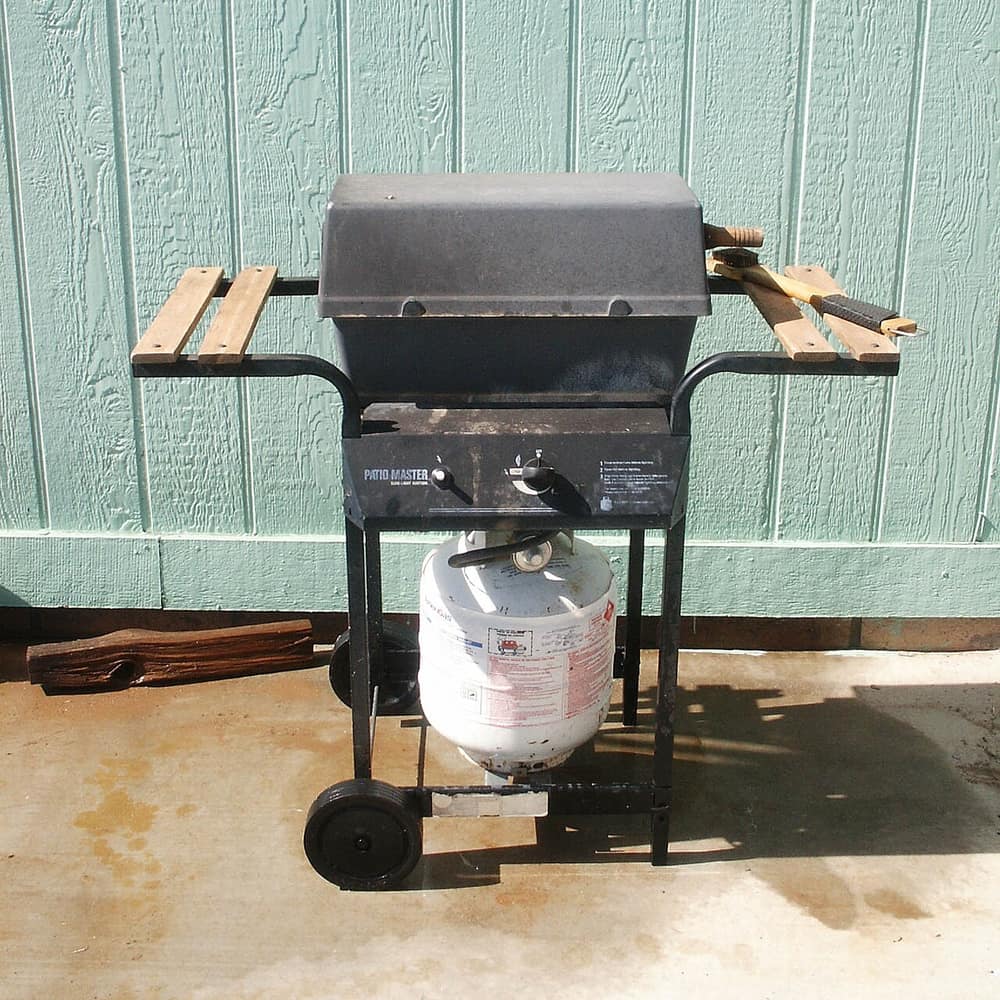
The most common type: a cooking box with two to six burners on a trolley with wheels, side shelves and space underneath to keep the cylinder. Most have a lid with a thermometer, and some add a side burner for a pot or sauce.
Best for: homes that braai regularly and want an outdoor kitchen feel.
Table-top and portable gas braai
Compact one- to four-burner units that sit on a table or fold up for travel. Many run off a smaller cylinder or a cartridge.
Best for: small balconies, camping, caravanning, and as a second braai.
Gas skottel and plate cookers
A skottel is a shallow, wok-like pan over a single gas burner, ideal for breakfasts, stir-fries and boerewors rolls on the go. See our skottel braai guide.
Built-in gas braai
A gas braai unit built into a masonry counter or braai room, often connected to a fixed gas supply. A fixed gas installation must be done by a registered gas installer, who issues a Certificate of Conformity (CoC). Get quotes from registered gas installers, and read our explainer on the gas Certificate of Conformity.
Hybrid gas and charcoal braais
Most hybrids look like a trolley gas braai but have a charcoal basket or ember drawer that sits above the burners. You load it with briquettes (or wood, on some built-in models), light them with the gas, and once they are going you can turn the gas off and cook over coals. On a weeknight you leave the basket out and braai on gas as usual.
With Outback’s hybrids, for example, you remove the vapour bars, lay one layer of briquettes in the basket and run the burners until the briquettes turn red and grey (retailers say around 15 minutes). Chad-O-Chef sells a cabinet Hybrid Braai with an ember drawer, plus a hybrid attachment for its 3- and 4-burner Sizzlers.
Best for: households split between “gas is easier” and “it’s not a braai without coals”.
Gas braai types compared
| Type | Burners | Lid | Cylinder | Price band | Best for |
|---|---|---|---|---|---|
| Patio / trolley | 2–6 | Yes | Standard cylinder in the trolley | Entry-level to premium | Regular home braais |
| Table-top / portable | 1–4 | Usually | Small cylinder or cartridge | Entry to mid-range | Balconies, travel |
| Skottel | 1 | No | Small to medium cylinder | Entry to mid-range | Camping, breakfasts |
| Hybrid (gas + charcoal) | 3–6 | Yes | Standard cylinder or fixed supply | Upper mid-range to premium | Gas speed with coal flavour |
| Built-in | 3+ | Yes | Fixed supply or cylinder | Mid-range to premium | Braai rooms, outdoor kitchens |
Still unsure whether gas is right at all? Our which braai should I buy quiz matches you with a type in five questions.
What to look for
Number of burners
More burners means more cooking space and, importantly, more control. With three or more burners you can run one side hot and leave another off for indirect cooking, which is how a gas braai roasts a chicken or a leg of lamb.
- One to two burners: couples and small families.
- Three to four burners: most families and regular entertainers.
- Five or more: big groups, or people who cook whole meals outside.
Cooking area and heat output
Manufacturers quote heat output in BTUs (British thermal units) and the cooking area in square centimetres. Use both, together. A big BTU number spread over a large grid can heat no better than a smaller braai with fewer BTUs.
To give you a feel for real numbers, here is how one local range steps up:
| Megamaster model | Main burners | Total main-burner output | Main cooking area |
|---|---|---|---|
| Onyx 3 Burner | 3 | 30,000 BTU | 2,143.93 cm² |
| Pinnacle 3 Burner | 3 | 40,500 BTU | 2,718.7 cm² |
| Onyx 4 Burner | 4 (+ side burner) | 44,000 BTU | 2,718.70 cm² |
| Apex 6 Burner Gourmet Pro | 6 | 75,000 BTU (total) | 3,656.04 cm² |
Figures as listed by Megamaster (Nov 2026). Notice that two three-burner models can differ in both output and area, which is why the burner count alone doesn’t tell you everything.
Grid, griddle or both
A grid gives flame-grilled marks and lets fat drip away. A griddle plate (flat plate, sometimes sold as a plancha) is better for eggs, onions, seafood and anything that would fall through. Many gas braais let you swap a section of grid for a plate, and some come with both side by side. That is the most versatile setup.
Grid material
Cast-iron grids hold heat and sear well but need oiling. Enamel-coated cast iron resists rust. Stainless steel grids are easy to look after. Thicker rods generally mean better searing.
Lid and thermometer
A lid turns the braai into an outdoor oven: roasts, pizza, even baking. A lid thermometer helps, though it measures the air under the lid rather than the grid itself.
Build quality
Check the firebox and lid thickness, the burner material (stainless steel lasts longer), and how solid the trolley feels. At the coast, stainless steel or well-coated parts resist rust better.
Ignition
Push-button or rotary igniters are standard. Check that the manual explains how to light a burner by hand, in case the igniter fails.
Fat and grease management
A removable drip tray and grease cup make cleaning easier and reduce flare-ups and grease fires.
Spares and service
Choose a brand with local spares for burners, regulators and grids. Brands commonly sold in South Africa include Megamaster, Weber, Cadac, Jetmaster and Alva, among others. Our Megamaster braai guide and Weber braai guide explain how those two ranges are organised.
Cylinder and regulator setup
- Use the cylinder size and regulator the manufacturer specifies. Many patio braais are designed around a standard LP gas cylinder kept in the trolley.
- Buy and swap or refill cylinders through reputable gas dealers.
- Make sure the regulator and hose suit your braai and are in good condition. Replace cracked, stiff or perished hoses.
- Keep the cylinder upright, outdoors, and away from heat sources and the braai’s hot surfaces.
How long does a gas cylinder last on a gas braai?
A kilogram of LPG holds roughly 13.8 kWh of energy, so divide that by how hard your braai is burning and you have kilograms per hour.
Take the Megamaster Onyx 4 Burner, listed at 44,000 BTU for its main burners. One kilowatt is about 3,412 BTU an hour, so that’s roughly 12.9 kW with every burner on full. It burns a little over 900 g of gas an hour, and a 9 kg cylinder would last a bit under 10 hours flat out.
Nobody braais with every knob on high all session, though. The table uses two assumed loads for a four-burner braai: 12 kW with everything on full, and 6 kW for a typical cook with burners on medium or one side off.
| Cylinder | All burners on full (12 kW) | Typical cook (6 kW) |
|---|---|---|
| 3 kg | about 3.5 hours | about 7 hours |
| 5 kg | about 6 hours | about 11.5 hours |
| 9 kg | about 10 hours | about 21 hours |
| 19 kg | about 22 hours | about 44 hours |
At the typical load, an hour-and-a-half braai uses roughly 650 g, so a 9 kg cylinder covers a dozen or so family braais. Treat these as estimates: a side burner, long lid-down roasts and windy days all burn more. For your own braai, take the rating from the manual or rating plate and plug it into our gas cylinder calculator.
Before your first braai: setup and burn-off
A new gas braai needs a little prep before the first chop goes on. Your manual has the final say, because steps and timings differ between brands.
- Unpack fully. Take out every bit of packaging, cable ties and any protective film from the firebox, burners and grids.
- Check the gas parts. Confirm the regulator and hose are the type the manual specifies and that every joint is secure, then connect the cylinder and do the soapy-water leak test described below.
- Light with the lid open, one burner at a time, following the manual’s lighting order.
- Burn it off. Many manuals say to run a new braai on high with the lid closed, often for around 15 minutes, before the first cook, to burn off oils left from manufacturing. Times vary from brand to brand, so follow yours.
- Season cast-iron grids. Once cool, wipe them with a thin coat of cooking oil. Stainless grids usually just need a brush.
- Preheat before every cook. Megamaster suggests 7–10 minutes, with the lid closed, so the grids heat through. It puts wood or charcoal at up to 40 minutes before the coals are ready.
Gas braai safety
- Leak test every time you connect a cylinder. Brush soapy water over the cylinder valve, regulator and hose joints with the gas on. Bubbles mean a leak: turn the gas off at the cylinder and fix the connection before lighting.
- Open the lid before lighting. Lighting with the lid closed can trap gas and cause a flash.
- Never use a gas braai indoors or in an enclosed space. Burning gas uses oxygen and produces carbon monoxide.
- Turn the cylinder off at the valve after every braai, not just the burner knobs.
- Keep a fire extinguisher or fire blanket nearby. Our fire extinguisher guide explains which type suits a home.
- If you smell gas and can’t find the leak, turn off the cylinder, don’t light anything, and have the braai checked.
Gas braais worth buying
Five in-stock options from three South African stores, from a balcony-sized table-top to a six-burner for big gatherings and a gas-and-charcoal hybrid.

ALVA
Alva Everest Tabletop 3-Burner Gas BBQ with Grill, Plancha Plate & Cover
Three burners in a tabletop unit, with both a grill and a flat plancha plate. A neat fit for a townhouse patio or a balcony where gas is allowed.
- Tabletop
- 3 burners
- Grill and plancha plate
- Cover included
- Grid and griddle in one
- Small footprint
- No trolley or cylinder storage
- Limited space for a big family

Jetmaster
Jetmaster Atlanta Portable Gas Braai – 4 burner
Four burners in a portable stainless-steel unit from a local braai brand. A lot of cooking space for something you can move.
- 4 burners
- Portable
- Stainless steel finish
- Four-burner space without a full trolley
- Stainless finish suits outdoor use
- Check where the cylinder sits before you buy
- Fewer extras than trolley models

Megamaster
Onyx Series 4 Burner Patio Gas Braai
The family sweet spot: four main burners for indirect cooking plus a side burner for pap, sauce or a pot of mielies.
- 4 stainless steel burners, 44,000 BTU
- 12,000 BTU side burner
- 2,718.70 cm² main cooking area
- Cast-iron grids
- Side burner handles the sides
- Enough space for a family braai
- Patio trolley needs floor space
- Cast-iron grids need oiling
Jetmaster
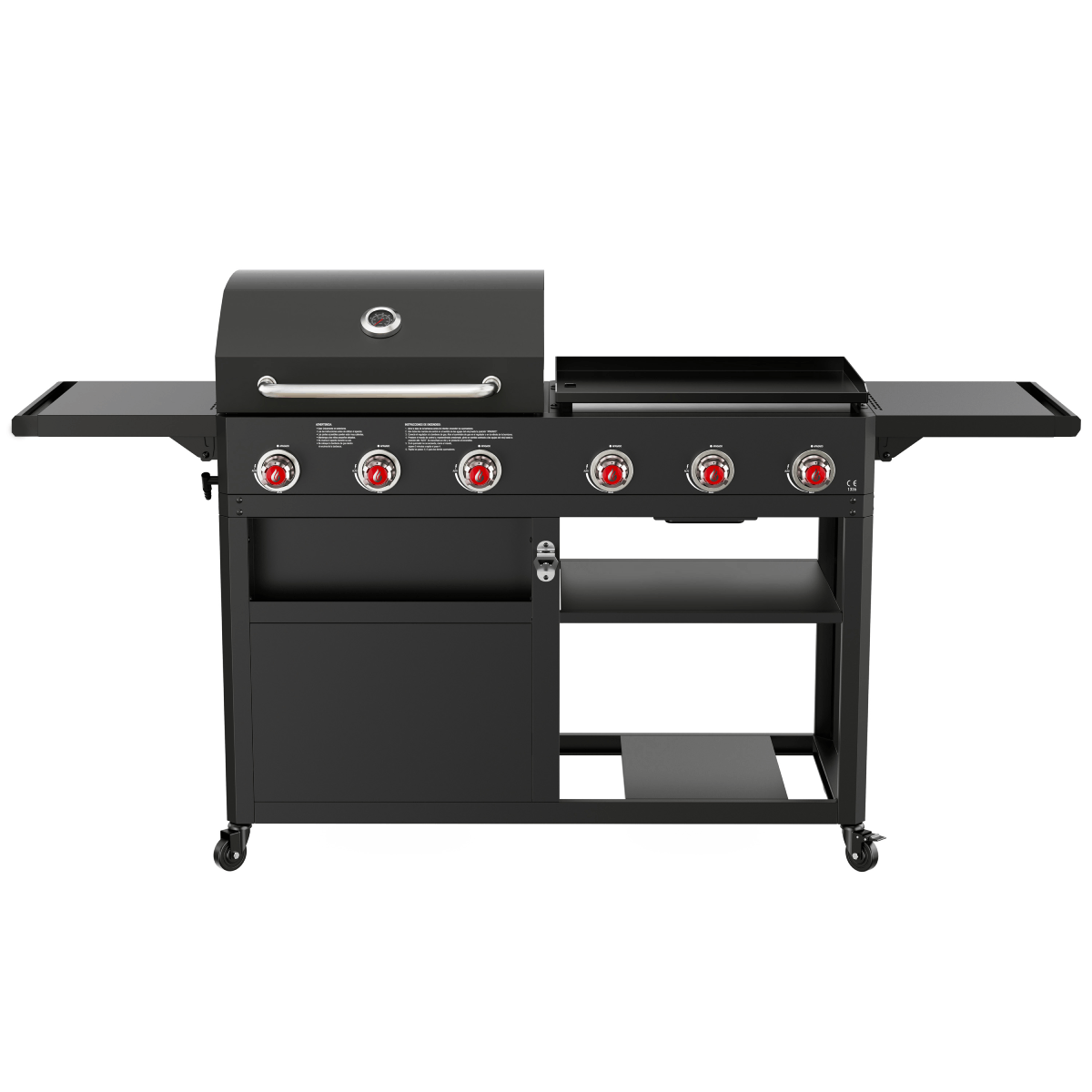
Jetmaster Fusion 6 Burner Gas Braai – 6 burner – New!
Six burners split between a grill side and a flat wok side, so the chops and the eggs-and-onions happen at the same time.
- 6 burners
- 3 grill + 3 flat wok sections
- Grid and flat top side by side
- Feeds a crowd
- Big unit for a small patio
- Uses more gas at full tilt

Outback
Outback Ranger Hybrid 3 Burner Braai, Gas and Briquettes
A three-burner trolley braai with a charcoal basket, so you can light briquettes with the gas when you want coal flavour and cook on plain gas the rest of the week.
- 3 burners
- Gas and briquettes
- Charcoal basket
- Wooden trolley
- Gas convenience with a charcoal option
- Multi-cooking surface takes extra accessories
- Costs more than a plain three-burner gas braai
- Ash to clean out after charcoal cooks
Prices change often; check the retailer for the current price and stock. We may earn a commission if you buy through these links, at no extra cost to you. Star ratings are the store's own customer reviews, shown once a product has at least 3. How we choose products.
What a gas braai costs in South Africa
Prices climb in clear steps. These bands use in-stock examples from South African stores (Nov 2026); specials come and go, so treat them as a guide to what each budget buys.
| Budget | What you get | Examples (Nov 2026) |
|---|---|---|
| Under R5,000 | Table-top units, often with a plate | Alva Everest 3-burner table-top, around R4,299 at Alva |
| R5,000–R10,000 | Portable four-burners, entry patio trolleys, griddle stations, smaller drop-ins | Jetmaster Atlanta 4-burner, around R6,699 at Braai Culture; Megamaster Onyx 4 Burner, around R7,499 at Megamaster; Jetmaster Fusion 6, around R9,499 at Braai Culture |
| R10,000–R20,000 | Big patio braais, stainless gas grill inserts for built-ins, most hybrids | Outback Ranger Hybrid 3 Burner, around R13,999 at Braai Culture; Megamaster Apex 6 Burner Gourmet Pro, around R16,999 at Megamaster |
| R20,000 and up | Heavy stainless built-ins, hybrids with rotisserie domes, premium hybrids | Chad-O-Chef 4 burner Hybrid, around R39,999; Chad-O-Chef Hybrid Braai 3 burner with rotisserie dome, around R54,150, both at Braai Culture |
For a built-in, the braai is only part of the bill: a fixed gas line needs a registered installer and a CoC, and the masonry or cladding costs extra.
Buying checklist
- Burner count suits your usual group size
- Cooking area measured, not guessed
- Lid with thermometer, if you want to roast
- Grid material you’re happy to maintain
- Option to add or swap in a griddle plate
- Solid trolley, stainless burners, removable drip tray
- Correct regulator and hose included or available
- Spares available locally
- Allowed by your body corporate or estate rules
Where to buy
Gas braais are sold at Builders, Makro, Game and other large retailers, on Takealot, and at specialist braai and gas shops, which are usually best for advice on regulators, cylinders and spares. Megamaster, Weber and Alva also sell through their own online stores.
Care and maintenance
- Burn off residue for a few minutes on high after cooking, then brush the grid.
- Empty and clean the drip tray regularly to prevent grease fires.
- Inspect the hose and regulator each season.
- Keep the braai covered when not in use.
For a deep clean of the grids, burners, venturi tubes and drip tray, see how to clean a gas braai.
Gas braai problems and quick fixes
Most gas braai faults come down to a handful of causes, and the fix is often a brush or a battery rather than a new braai. Close the cylinder valve and let everything cool before you take parts out.
| Problem | Likely cause | What to try |
|---|---|---|
| Igniter clicks but the burner won’t light | Dirty or cracked electrode, loose wire, or no gas reaching the burner | Light the burner by hand the way the manual shows. If it lights, the fault is the igniter: clean the electrode tip and the burner near it, and check the wires. If it won’t light by hand either, look at the gas supply instead. |
| Igniter doesn’t click at all | Flat or wrongly fitted battery (on battery igniters), loose wire or a failed igniter module | Fit a fresh battery the right way round and reconnect the wires; if it still won’t click, order a replacement igniter for your model. |
| Yellow, lazy or sooty flames | Spider webs or insect nests in the venturi tubes, or the air shutter set wrong | Clean the tubes with a venturi brush. A healthy flame is mainly blue; a little yellow at the tips is normal. |
| Low flame on every burner | Tripped regulator safety feature, nearly empty cylinder or a kinked hose | Reset the regulator (steps below), weigh the cylinder and straighten the hose. |
| One burner weak or patchy | Blocked burner ports, or a burner rusted through between the ports | Clear the ports with a toothpick or straightened paper clip. A corroded burner needs replacing, not patching. |
| Constant flare-ups | Grease on the vaporiser bars, burners or in the drip tray | Clean the braai, empty the drip tray, trim excess fat and move fatty cuts to a cooler zone. |
How to reset a tripped regulator
Modern regulators can restrict the gas flow when they sense something irregular, and sometimes they trip when nothing is wrong.
- Turn all the burner knobs off and close the cylinder valve.
- Disconnect the regulator and wait about a minute.
- Reconnect it securely and open the cylinder valve slowly.
- Light one burner as usual. If the flame is still weak, do a soapy-water leak test and replace the regulator if it won’t behave.
FAQ
How many burners does a gas braai need?
For most families, three or four burners is a good balance. It gives enough space for a family meal and lets you cook indirectly by switching off one burner. Couples and balcony braaiers can manage with one or two.
Is a gas braai as good as charcoal?
Gas wins on speed and control; charcoal and wood give more smoky flavour. With a lid and a smoker box of wood chips a gas braai gets closer, and a hybrid lets you cook over real briquettes when you want to. Our gas vs charcoal vs wood comparison goes through it in detail, and the smoker braai guide covers low-and-slow smoking.
Can I use a gas braai on a balcony?
Often, but check your body corporate or estate rules first. Keep it well away from anything flammable, make sure there’s plenty of ventilation, and never use it in an enclosed space.
Do I need a CoC for a gas braai?
A portable gas braai connected to its own cylinder doesn’t need a fixed installation. A fixed gas installation, such as a gas line piped to a built-in braai, must be installed by a registered gas installer, who issues a Certificate of Conformity.
Can I convert a gas braai to natural gas?
Only if the manufacturer offers a conversion kit for your exact model. Natural gas runs at a different pressure from LPG and needs different jets and often a different regulator, so a generic jet set isn’t a safe shortcut. Because the braai is then connected to a fixed gas supply, have a registered gas installer do the conversion and issue a CoC; our gas Certificate of Conformity explainer covers what that involves.
How do I know how much gas is left in my cylinder?
Weigh it. The empty (tare) weight is usually stamped on the cylinder’s collar or neck ring, often marked TW or TARE. Subtract that from what the scale shows and the difference is the gas left inside. Tare weights differ between cylinders, so always use the number stamped on yours.
Can I leave the gas cylinder connected to my braai?
Yes, as long as you close the cylinder valve every time you finish cooking, not just the burner knobs; Megamaster’s manuals say the gas must be turned off at the cylinder when the braai isn’t in use. Keep the cylinder upright, outdoors and in a ventilated spot, and leak test it whenever you reconnect it. If you store the braai indoors over winter, disconnect the cylinder first and keep it outside.

Johan Botha
Braai & outdoor editor
Writes our braai, fire pit and pizza oven guides. Firmly in the wood-fire camp, but owns up to a gas braai for weeknights.
More from Johan →