We're independent: products are chosen on merit and prices come from the retailers' own sites. We may earn a commission if you buy through our links. Learn more.
Key takeaways
- A skottel is a wide, shallow gas pan: the dipped centre collects the fat, so you can fry in the middle and keep food warm on the sides.
- A skottel on legs is more stable than a cylinder-top one and keeps the cylinder away from the heat.
- Size the pan to your group: around 30cm for one or two, 35–40cm for a small family, 45–50cm for a crowd.
- Outdoors only, leak test every connection, and keep a fire blanket for pan fires. Never throw water on burning oil.
Every South African campsite has the same soundtrack at 7am: the hiss of a gas cylinder, the click of a lighter and bacon hitting a hot skottel. It’s the camping cooker this country grew up with, and it’s just as handy on the patio for a Saturday breakfast or a quick boerewors roll.
A skottel braai is a shallow, wok-shaped pan that sits on a single gas burner, usually mounted on a cylinder or a set of folding legs. This guide explains how a skottel works, which type and size to buy, what to cook on it (with three simple skottel recipes), and how to use and look after it safely.
Quick answer: which skottel setup?
| You mostly… | Choose | Pan size |
|---|---|---|
| Do day trips and quick breakfasts for two | Cylinder-top skottel | Around 30cm |
| Camp as a family, cook on the patio | Skottel on legs with hose and regulator | Around 35–40cm |
| Camp often and want grill plates too | Multi-function camping cooker | Varies by model |
| Feed a crowd | Large skottel on legs | Around 45–50cm |
Choose one by size (how many people you feed), how it mounts, and which extra pans and plates you want.
What is a skottel?
“Skottel” is Afrikaans for a dish or basin, which describes the pan: wide and curved, with a slightly deeper centre. Fat and juices run to the middle, so you can cook bacon and eggs on the sides while onions fry in the centre. The design is closely linked to Cadac, a company founded in Johannesburg in 1948, and the name “Cadac skottel” is often used for any skottel in South Africa.
The skottel itself is just the pan. A complete skottel braai is pan + burner + stand or cylinder mount + gas cylinder.
Types of skottel braai
Cylinder-top skottel
The burner screws directly onto the top of a gas cylinder, and the pan sits on the burner. It’s the simplest and cheapest setup, but the cooking height is fixed by the cylinder size, and it can be top-heavy. Use it only on firm, level ground.
Skottel on legs
The burner sits on a three-legged stand, connected to the cylinder by a hose and regulator. It’s more stable, puts the pan at a comfortable height and keeps the cylinder away from the heat.
Multi-function camping cookers
Cadac’s range includes portable gas cookers sold with several interchangeable tops: a skottel pan, a ribbed grill plate, a flat plate and sometimes a pot stand or pizza stone. Families sold include Safari Chef (compact), Grillo Chef (mid-sized) and Carri Chef (larger), along with table-top cookers. Some come with a carry bag and fold into a compact pack. Model names and the pans included vary by version, so check the box contents before buying.
Table-top and plate cookers
Small two-plate or single-plate gas cookers that sit on a table, including butane-canister models that need no cylinder at all. They overlap with portable gas braais; see our gas braai buying guide if you need more cooking area.
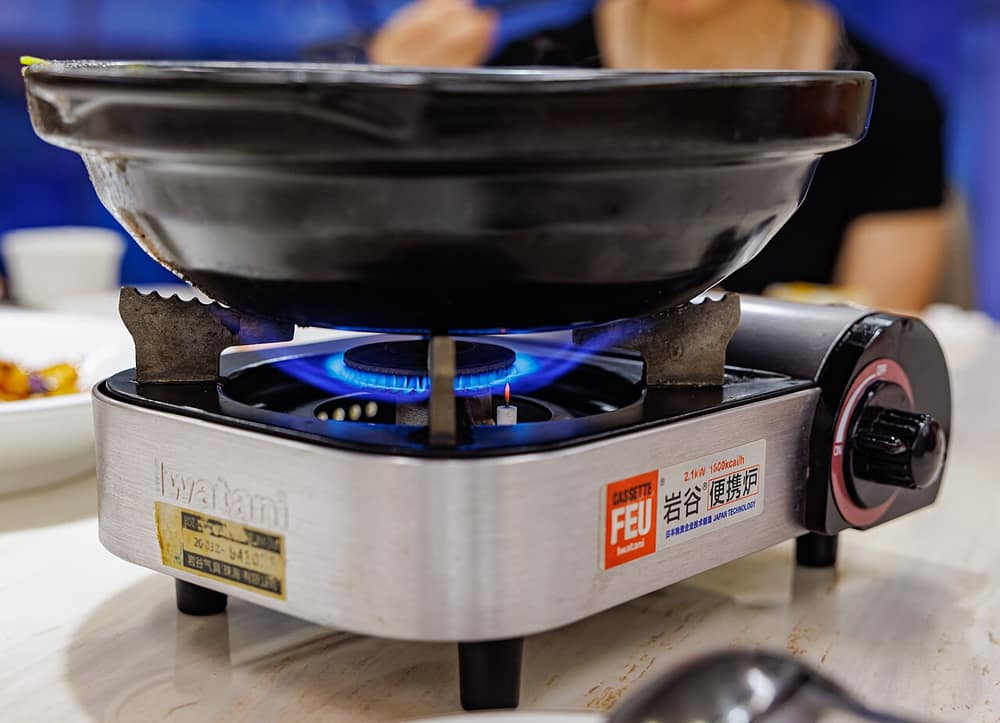
Skottel types compared
| Type | Stability | Portability | Versatility | Price band | Best for |
|---|---|---|---|---|---|
| Cylinder-top | Fair | Very good | Pan only | Entry-level | Quick breakfasts, day trips |
| Skottel on legs | Good | Good | Pan, sometimes extras | Entry to mid-range | Camping, home patio |
| Multi-function cooker | Good | Good (packs into bag) | Several tops | Mid-range to premium | Regular campers, caravanners |
| Table-top plate cooker | Good | Good | Plates | Entry to mid-range | Balconies, picnics |
Choosing the right size
Skottel pans are sold in several diameters. As a rough guide:
- Small pans (around 30cm or less): one or two people, hiking or light camping.
- Medium pans (around 35–40cm): small families.
- Large pans (around 45–50cm): families and groups, or cooking several things at once.
Bigger pans need more space and gas, and a stable stand. If you camp with a group, a larger pan on legs is easier than cooking in batches.
What to look for
- Stability. Wide legs or a stable base, especially if you’ll cook with children around.
- Pan coating. Non-stick or enamel pans clean easily; look after them with wooden or silicone utensils.
- Burner and flame control. A burner that spreads heat across the pan avoids a scorching centre. Good low-flame control matters for eggs and pancakes.
- Regulator and hose. Check what’s included and that it suits your cylinder.
- Wind protection. A windshield helps a lot at the beach or on an open campsite.
- Extras. Ribbed grill plates, flat plates, lids and carry bags add value if you’ll use them.
- Spares. Choose a model with locally available replacement pans, burners and regulators.
What to cook on a skottel
- Full breakfast: bacon, eggs, boerewors, tomatoes, mushrooms.
- Breakfast rolls and toasted sandwiches.
- Stir-fries and curries in the deep centre.
- Pancakes and flapjacks on the flat sides, on low heat.
- Prawns, calamari and fish with garlic butter.
- Steak strips, chicken livers or trinchado.
Three easy skottel recipes
The campsite breakfast (serves 4)
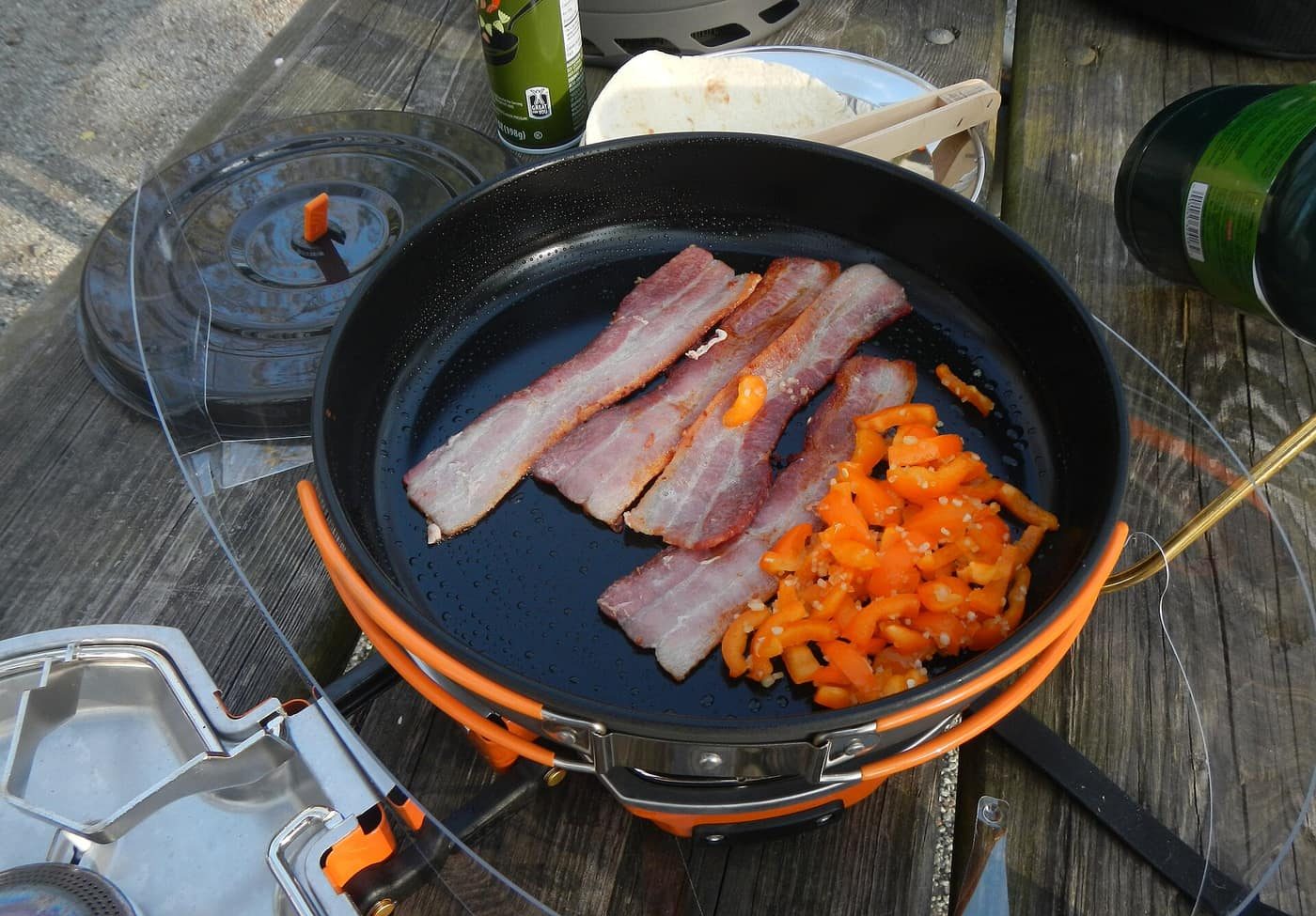
- Heat the skottel on medium. Fry 8 rashers of bacon in the centre until crisp, then move them to the rim.
- Fry 4 halved tomatoes and a punnet of sliced mushrooms in the bacon fat. Season and slide them outwards.
- Turn the heat to low, crack 4 to 8 eggs into the centre and cook to your liking.
- Toast bread or rolls face-down on the edge of the pan for the last minute.
Boerewors and onion rolls (serves 4–6)
- Fry 2 sliced onions in a little oil in the centre on medium heat until soft and golden, then push them to the sides.
- Add 1kg of boerewors in a coil and fry for 12 to 15 minutes, turning once, until cooked through.
- Cut into lengths, load into rolls with the onions and add chutney or tomato sauce.
Garlic-butter prawns (serves 2–4)
- Melt 3 tablespoons of butter in the centre on medium heat with 3 crushed garlic cloves.
- Add 500g of cleaned prawns and fry for 2 to 3 minutes a side until pink.
- Finish with lemon juice and chopped parsley. Serve with bread to mop up the butter.
For more inspiration, see our braai ideas, many of which work on a skottel too. Feeding a bigger group? The braai meat calculator helps with quantities.
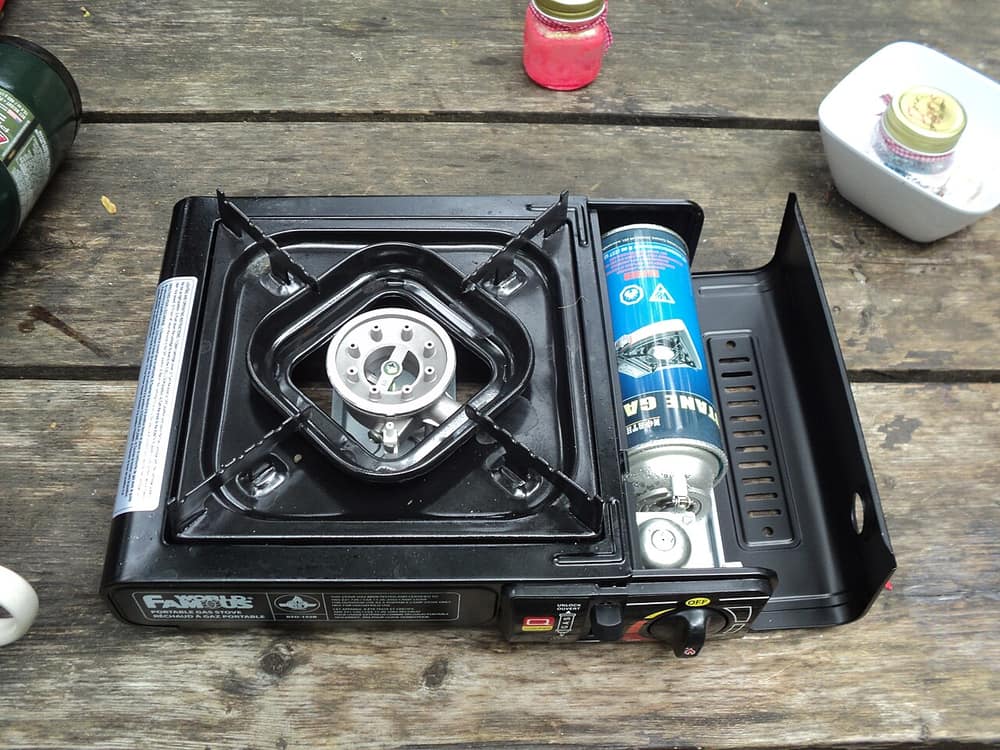
Skottel gas safety
- Leak test every time you connect the burner or regulator: brush soapy water over the joints with the gas on. Bubbles mean a leak. Turn off the cylinder and fix it before lighting. Our gas cylinder safety guide covers the test, hoses and carrying cylinders in the car.
- Keep the cylinder upright and outdoors. Never use a skottel inside a tent, caravan, car or closed room: gas burners use oxygen and can produce carbon monoxide.
- Set up on level, firm ground, away from tent walls, dry grass and overhanging branches.
- Light with care: have the flame ready before you open the gas, and keep your face away from the burner.
- Turn off the cylinder valve when you finish, not just the burner tap.
- Let it cool before packing it away.
- Keep a fire blanket handy, especially for fat fires in the pan. Our fire blanket guide explains how to use one. Never throw water on burning oil.
Gear for your skottel
We couldn’t find Cadac skottels in stock at the retailers we track, so these are the supporting pieces: burner, gas, a level indicator, a table-top alternative and the fire blanket every camping box should have.

ALVA
Alva Potjie Cooker Top - Gas Burner for 3kg & 5kg LPG Cylinders
A simple burner that connects straight onto a 3kg or 5kg LP gas cylinder. Alva sells it for potjies and wok cooking; it's the same idea as a cylinder-top skottel burner.
- Fits 3kg and 5kg LPG cylinders
- 210 g/hr gas consumption
- Cheap and compact
- No hose to pack
- Check your pan sits securely before cooking
- Cylinder-top setups are top-heavy

ALVA
3Kg LPG Gas Cylinder (Empty)
The small cylinder most portable gas cookers are built around. Light enough to carry to the campsite with one hand.
- 3kg capacity
- Vertical 3/8" valve outlet
- Valve shroud doubles as a handle
- LPGSA approved
- Lightest cylinder in the range
- Shroud protects the valve
- Sold empty: fill it before the trip
- Runs out sooner than a 5kg

Alva
Gas Cylinder Level Indicator - Magnetic
A magnetic strip that shows roughly how much gas is left. Cheaper than running out halfway through the breakfast eggs.
- Magnetic
- Clips onto the cylinder
- Takes the guesswork out of packing
- Very cheap
- An indication, not an exact reading

ALVA
Butane Gas Canister Mini BBQ Cooker Stove + Carry Case
If you'd rather not carry a cylinder at all, this mini gas braai runs on butane canisters and packs into its own case.
- Butane canister
- Stainless steel burner
- Piezo ignition
- Carry case
- No cylinder or hose
- Packs neatly for picnics
- Runs on disposable canisters, not a refillable cylinder
- Smaller cooking area than a big skottel

Arbor Safety Co
Glass Fibre Fire Blanket
A pan of hot oil is the most likely fire at any skottel breakfast. A fire blanket smothers it; water makes it far worse.
- 2m × 2m
- Glass fibre
- EN 1869:1997
- Red quick-pull bag
- Smothers a pan fire without mess
- Light enough for the camping box
- Single use: replace it after a fire
Prices change often; check the retailer for the current price and stock. We may earn a commission if you buy through these links, at no extra cost to you. Star ratings are the store's own customer reviews, shown once a product has at least 3. How we choose products.
Care and maintenance
- Wipe the pan out with paper towel while warm, then wash with warm soapy water and a soft sponge.
- Avoid steel scourers and metal utensils on coated pans.
- Dry pans fully before packing to prevent rust on any exposed steel.
- Keep the burner jet clean and check it for spiders and dust before each trip.
- Inspect the hose and regulator regularly and replace them if they look cracked or perished.
- Store the skottel in its bag or box, and store cylinders upright in a ventilated area.
The burner on a skottel suffers from the same spiders and grease as a bigger gas braai, so the burner and hose checks in how to clean a gas braai apply here too.
Skottel problems and quick fixes
Most skottel trouble at the campsite comes down to gas supply, a blocked jet or wind. Before you fiddle with anything, turn off the burner tap and the cylinder valve, and let the burner cool.
| Problem | Likely cause | What to do |
|---|---|---|
| Won’t light at all | Cylinder valve closed, cylinder empty, or a blocked jet | Open the cylinder valve fully and check the gas level. If there’s gas but no flame, clean the jet as the manual describes; spider webs, insects and dust are common culprits. |
| Lights, then blows out | Wind across the burner | Turn the burner tap off at once, wait for the gas to clear, then relight behind a windshield or in a sheltered spot. |
| Yellow, lazy or sooty flame | Too little air mixing with the gas: a blocked air inlet or burner tube, or a burner that isn’t seated properly | A healthy flame is steady and mostly blue. Stop cooking, clear the air inlet and burner, and check the burner sits correctly. If the flame stays yellow, have it serviced or replace the burner. |
| Weak flame from the start | Kinked hose, a partly blocked burner, or a regulator whose safety feature has cut back the flow | Straighten the hose. On a hose-fed skottel, reset the regulator: burners off, cylinder closed, disconnect the regulator, wait a minute, reconnect, then open the cylinder slowly. Replace a regulator that still gives a weak flame. |
| Flame fades during a long cook and the cylinder frosts | Gas is being drawn faster than a small cylinder can vaporise it, or the cylinder is nearly empty | Turn the flame down and give it a break, or use a bigger cylinder on a hose. Never warm a cylinder with a flame, boiling water or a heater. |
| Smell of gas or a hiss at a joint | A leak | Close the cylinder valve if it’s safe to reach, put out any flame nearby and keep sparks away. LPG sinks and pools, so let it clear. Once the smell has gone, do the soapy-water test and don’t relight until the leak is fixed. If the smell won’t go, move everyone away and call for help. |
| Food burns in the middle, stays raw at the rim | Flame too high for the pan | Cook on medium, sear in the centre and finish on the cooler rim. |
Skottel vs gas braai
A skottel is a pan cooker: ideal for frying, sautéing and breakfasts. A gas braai with a grid and lid is better for chops, steaks, roasts and big groups. Many campers take a skottel for breakfast and use a wood or charcoal braai at night, with a folding stand or tripod from our braai stand guide. Our camping braai guide covers that two-cooker setup, plus firewood and fire rules in parks and campsites. For a single beach or picnic outing with no gas to carry, a disposable braai is the throwaway option, as long as the spot allows fires. If you’re deciding on a main braai, see how to choose a braai.
FAQ
What is a Cadac skottel?
It’s a gas-fired skottel braai from Cadac, a company founded in South Africa. Because Cadac’s skottels became so well known, many South Africans use “Cadac” and “skottel” to mean any shallow gas pan braai.
Can you braai meat on a skottel?
Yes, you can fry boerewors, steak, chops and chicken on a skottel, but it pan-fries rather than grills over coals. For grill marks, use a ribbed grill plate if your cooker has one.
What gas cylinder do I need for a skottel?
It depends on the model. Cylinder-top skottels screw onto specific cylinder valves; skottels on legs use a hose and regulator. Use the cylinder and regulator the manufacturer specifies and buy gas from reputable dealers.
Can I use a skottel indoors?
No. Use skottels only outdoors with good airflow. Gas burners use oxygen and can produce carbon monoxide in enclosed spaces like tents, caravans and rooms.
How do I clean a skottel pan?
Wipe out excess fat while warm, then wash it in warm soapy water with a soft sponge and dry it fully. Avoid steel wool and metal utensils on non-stick or enamel coatings.
How long does a gas cylinder last on a skottel?
It depends on the burner and how high you run it. As one example, Alva rates its cylinder-top burner at 210g an hour, which works out to roughly 14 hours at full flame on a 3kg cylinder.

Johan Botha
Braai & outdoor editor
Writes our braai, fire pit and pizza oven guides. Firmly in the wood-fire camp, but owns up to a gas braai for weeknights.
More from Johan →