We're independent: products are chosen on merit and prices come from the retailers' own sites. We may earn a commission if you buy through our links. Learn more.
In an emergency, get everyone out first and call 112 from a cellphone, or your local fire brigade. This guide is general information; always follow the manufacturer's instructions and local regulations.
Key takeaways
- For most homes, an ABC dry chemical powder (DCP) extinguisher of 2.5 kg to 4.5 kg, mounted near the kitchen exit, is the sensible main unit.
- Add a fire blanket for pan fires: powder at close range can blast burning oil out of the pan.
- Check it yourself monthly and have it serviced yearly by a SANS 1475 permit holder. Recharge it after any use.
- An extinguisher is only for a small fire with a clear exit behind you. If it's spreading, get everyone out and dial 112.
Most of us only think about fire extinguishers when we walk past one in a shopping centre. Then the oil on the stove catches, or smoke curls out of the plug behind the TV, and suddenly the question is very real: do you have one, can you reach it, and does it still work?
For most South African homes the answer is simple. Buy an ABC dry chemical powder (DCP) extinguisher, mount it near an exit in or close to the kitchen, add a fire blanket for pan fires, and have it serviced every year. This guide covers which type and size to buy, where to put it, how to use it and clean up afterwards, how servicing and pressure testing work, and the fires you should never try to fight yourself.
Quick answer: the home fire kit
| Where | What to have | Why |
|---|---|---|
| Kitchen (near the exit) | 2.5 kg or 4.5 kg ABC DCP, plus a fire blanket | Covers most household fires; the blanket handles pans of oil |
| Garage or workshop | 4.5 kg or 9 kg ABC DCP | Fuel, paint, gas cylinders and generators |
| Braai area or lapa | 2.5 kg ABC DCP, ideally a blanket too | Outdoor cooking with gas, oil and open flame |
| Home office or DB board | Optional CO2 unit | No powder residue on electronics |
| Car or caravan | 1 kg to 2.5 kg ABC DCP on a bracket | See our car fire extinguisher guide |
First rule: people before property
An extinguisher buys you a few seconds against a small fire. It doesn’t make you a firefighter. Before you pick one up, run through this:
- Raise the alarm. Shout and get everyone moving towards the exit.
- Call for help. From a cellphone, dial 112. For the police, call 10111. Save your local municipal fire and rescue number in your phone today, because the number differs from city to city.
- Only fight a fire that is small, contained (a pan, a bin, a small patch of floor) and not spreading to walls or ceilings.
- Keep your back to the exit. If the extinguisher doesn’t knock the fire down in the first few seconds, or the room fills with smoke, leave and close the door behind you.
Never go back into a burning building for belongings.
Which type for a home?
South African suppliers sell five main types. Our fire extinguisher types guide explains the fire classes in detail. Here’s the household version:
| Type | Fire classes (check the label) | Good for at home | Don’t use on |
|---|---|---|---|
| DCP (dry chemical powder), ABC | A, B, C | All-round use: furniture, paper, petrol, paraffin, gas fires, and many models are also marked safe on live electrical equipment | Cooking oil or fat fires (can spread burning oil). It also leaves a fine powder everywhere |
| CO2 (carbon dioxide) | B, and electrical equipment | Studies, DB boards, electronics. Leaves no residue | Small, enclosed rooms (displaces oxygen); poor on solids like wood |
| Foam | A, B | Garages and workshops with fuels | Live electrical equipment, unless the label says otherwise; cooking oil |
| Water | A only | Wood, paper and fabric | Electrical, fat, oil, petrol or gas fires. Never use it on these |
| Wet chemical | F (cooking oils and fats), often A | Commercial kitchens, homes that deep-fry often | Electrical equipment, unless the label says otherwise |
For most homes that means ABC DCP as the main type, a fire blanket for the stove, and CO2 only as a specialist second unit. Our fire extinguisher picker suggests a type and size for each room in a few clicks.
Always read the label. It shows the classes the extinguisher is rated for, using letters and pictograms. Don’t assume colour tells you what’s inside.
What size do you need, and what does it cost?
DCP extinguishers are sold by the mass of powder inside. Common sizes, with the weight you will actually lift and the price at Arbor Safety (Nov 2026):
| Size | Weight full | Price | Typical use |
|---|---|---|---|
| 1 kg | About 1.8 kg | Around R241 | Cars, boats, caravans, braai kits. Very short discharge: a backup, not a home’s main unit |
| 2.5 kg | Not listed | Around R404 | Kitchen, flat, small home. Light enough for most adults |
| 4.5 kg | About 7.8 kg | Around R528 | Main extinguisher for a family home, garage or lapa |
| 9 kg | About 13.2 kg | Around R719 | Larger homes, workshops, farms. Heavy: make sure everyone can lift and aim it |
Other types cost more: around R833 for a 2 kg CO2, R875 for a 9 l water unit and R1,369 for a 6 l wet chemical unit at the same store. That’s one reason DCP is the default for homes and cars. And bigger is not always better: a 9 kg unit is no use if the person at home can’t lift it quickly.
Where to put it
- Near an exit, on the escape route. You should grab it on the way towards a fire and keep your exit behind you.
- Not right next to the hazard. An extinguisher beside the stove may be impossible to reach once the stove is on fire. A metre or two away, near the kitchen door, is better.
- Mounted on a bracket, at a height everyone can reach, not stuffed in a cupboard under the sink.
- Visible and unobstructed. Everyone in the house should know where it is.
- Out of direct sun and weather where possible. If you keep one at an outdoor braai or fire pit, use a cover or a sheltered spot.
- Garages and workshops need their own, especially where you store fuel, paint, gas cylinders or a generator.
What to look for when buying
- Certification. Portable extinguishers installed in buildings must comply with SANS 1910 under the building regulations (SANS 10400-T). Look for a certification mark on the label; industry sources name the SABS, BSI (Kitemark) and SACAS as certifying bodies.
- A full label. It should show the manufacturer, the fire classes, the agent and its mass, the working pressure and the test pressure. A label with missing details is a red flag.
- A fire rating such as “5A/21B”. The numbers refer to the size of the standard test fires (A for solids, B for liquids) the extinguisher put out, so higher numbers mean more firefighting power.
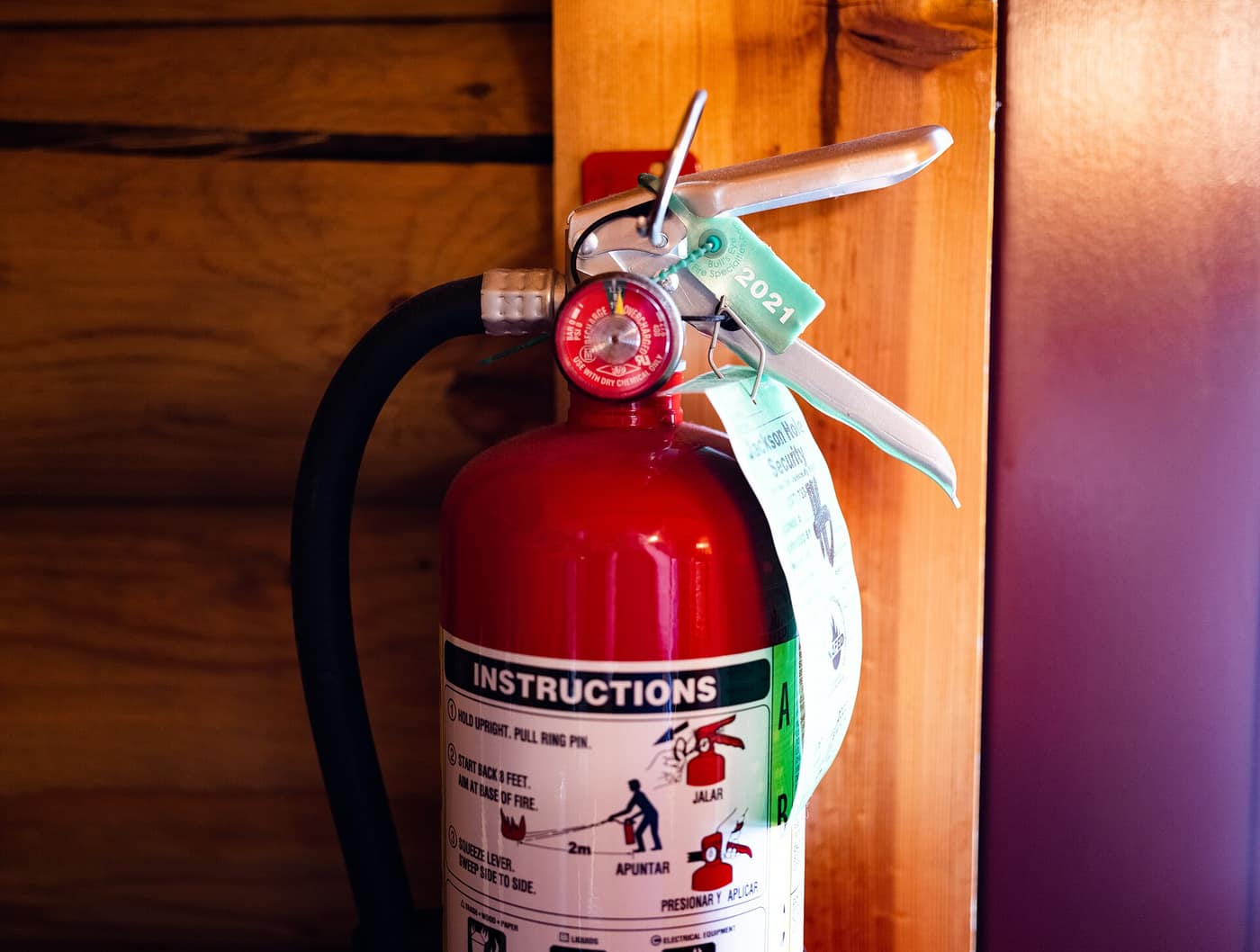
- A pressure gauge (on stored-pressure DCP units). The needle should sit in the green zone.
- A metal head and valve rather than plastic, where the budget allows.
- A wall bracket included in the box.
- A seller who can service it. Buying from a SANS 1475 permit holder means you can have it serviced and recharged by the same company.
Our picks
All in stock at a South African fire equipment supplier. Start with a DCP and the blanket.

Arbor Safety Co
4.5kg DCP Fire Extinguishers (Blue Crane)
The size we'd make a family home's main extinguisher. It comes with a discharge hose, which makes it easier to aim at the base of a fire from a safe distance.
- 4.5 kg ABC dry chemical powder
- Discharge hose and nozzle
- About 7.8 kg full
- Discharge time over 9 seconds
- Good balance of capacity and weight
- Hose makes aiming easier
- Leaves fine powder everywhere when used
- Not the tool for a pan of burning oil

Arbor Safety Co
2.5kg DCP Fire Extinguisher (Firemate)
A lighter ABC unit that most adults can grab and use without fuss. A good kitchen extinguisher in a flat, or a second unit for a lapa or braai area.
- 2.5 kg ABC dry chemical powder
- Supplier says it conforms to SANS 1910:2009 fire ratings
- Cylinder height 415 mm
- Light and easy to handle
- Compact enough for a small kitchen
- Less capacity than a 4.5 kg unit for a large home

Arbor Safety Co
9kg DCP Fire Extinguishers (Blue Crane)
The most capacity per rand in the range, for a big garage, workshop, smallholding or farm store. Only buy it if everyone likely to use it can lift it quickly.
- 9 kg ABC dry chemical powder
- About 13.2 kg full
- Discharge time over 12 seconds
- Working pressure 1,400 kPa
- Longest discharge in the DCP range
- Low price for its size
- Heavy: too much for some family members to lift and aim

Arbor Safety Co
2kg CO2 Fire Extinguisher (Alloy Steel)
Carbon dioxide leaves no residue, so it suits a study, DB board or server cupboard where powder would ruin equipment. A specialist second unit, not your main one.
- 2 kg carbon dioxide
- For flammable liquids and electrical hazards
- Supplier lists SANS 1567 certification
- No powder clean-up
- Suited to electrical equipment
- Poor on burning wood, paper and fabric
- Costs about twice as much as a 2.5 kg DCP

Arbor Safety Co
Glass Fibre Fire Blanket
The other half of a kitchen fire kit. It smothers a burning pan without disturbing the oil, which an extinguisher can't promise.
- 100% glass fibre
- 2 m × 2 m
- Complies with EN 1869:1997
- Red wall-hanging bag
- Simple for anyone to use
- Large enough to wrap a person
- Single use: replace it after a fire
Prices change often; check the retailer for the current price and stock. We may earn a commission if you buy through these links, at no extra cost to you. Star ratings are the store's own customer reviews, shown once a product has at least 3. How we choose products.
How to use it: PASS
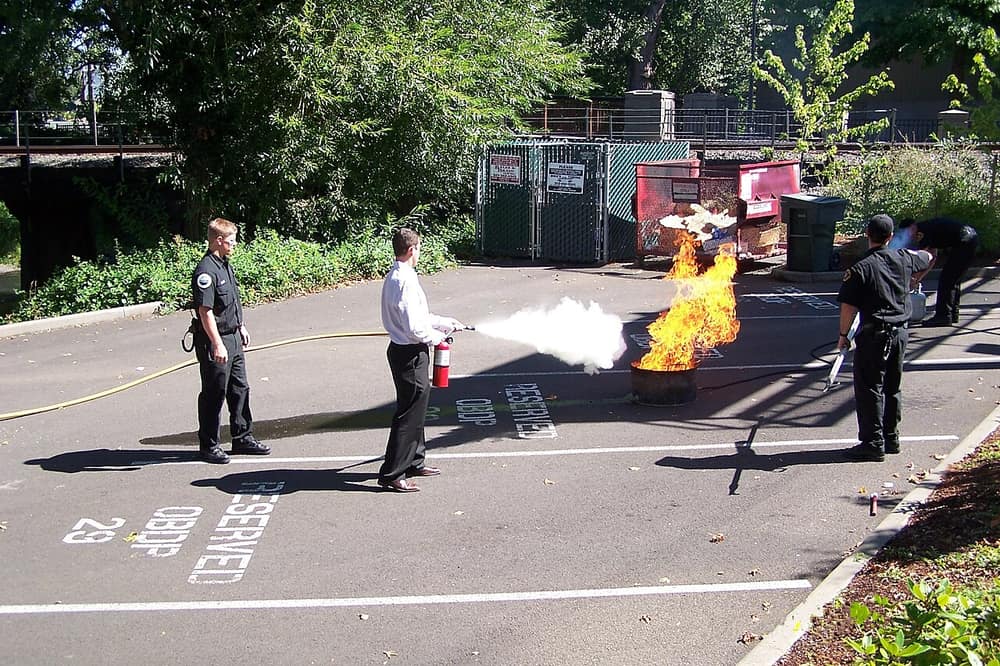
- Pull the pin (break the tamper seal).
- Aim the nozzle at the base of the fire, not the flames.
- Squeeze the handle.
- Sweep from side to side across the base of the fire.
Start about two to three metres away and move closer as the fire dies down. Back away rather than turning your back on it, and watch for re-ignition.
After you’ve used it
The fire is out, the room is white with powder and the extinguisher is half empty. Here’s what to do next, in order:
- Get the fire checked. Call the fire service anyway. Fires can smoulder inside walls, ceilings, couches and appliances and flare up again later.
- Get people out of the dust and air the room. Open windows and doors. ABC powder irritates eyes, skin and lungs, and CO2 displaces oxygen in a small room, so keep children and pets out until it clears.
- Leave appliances off. Don’t switch the stove, plug or DB circuit back on until an electrician or the fire service says it’s safe.
- Photograph everything before you clean. If you plan to claim, call your insurer first and ask how they want the damage recorded.
- Clean up dry first. Wear gloves and a dust mask, then sweep or scoop up as much powder as you can before using any water. ABC powder is usually monoammonium phosphate, which turns mildly acidic when it gets damp and can corrode metal and electronics, so don’t leave it lying for days. Wipe hard surfaces afterwards with a damp cloth. For powder inside a laptop, TV or appliance, get a professional to clean it.
- Recharge or replace the extinguisher straight away, even after a short burst. A partly used unit can lose pressure and fail next time. Don’t hang it back on the bracket as if nothing happened.
Fires an extinguisher at home shouldn’t tackle
- Pan and oil fires: turn off the heat if you can do it safely and smother the pan with a fire blanket. Never use water, and don’t use a powder extinguisher at close range, which can blast burning oil out of the pan.
- Electrical fires: switch off the power at the DB board if it’s safe to reach. Use only an extinguisher whose label says it’s suitable for electrical equipment. Never use water.
- Gas fires: close the cylinder valve if you can reach it safely. If you can’t, get out and call for help. See our gas heater safety guide.
- Lithium and solar battery fires: get out and call for help. Don’t try to fight these yourself. Read our lithium battery fire safety guide.
- Anything bigger than a waste bin, or anything that’s spreading to walls, curtains or the ceiling.
Servicing: SANS 1475 and SAQCC Fire
For businesses and other premises covered by the regulations, extinguishers must be serviced by a company holding a SANS 1475 permit (SANS 1475-1 covers the reconditioning of portable rechargeable extinguishers), using technicians registered with SAQCC Fire. SAQCC Fire is mandated by the Department of Employment and Labour to register people who work in the fire protection industry. Industry practice is a service at least every 12 months, recorded on a service tag. Your insurer, landlord, body corporate or local fire safety officer may have their own requirements.
Homes aren’t generally legally required to have their extinguishers serviced. You still should, because an unserviced extinguisher can fail when you need it.
Your 60-second monthly check
- It’s there, on its bracket, and nothing is blocking it.
- The pin and tamper seal are intact.
- The gauge needle is in the green.
- The body and hose show no rust, dents, cracks or damage.
- The service tag is less than a year old.
The rest of the routine
- Yearly (a professional): a service by a SANS 1475 permit holder, with a new service tag.
- Pressure testing: cylinders also need periodic pressure (hydrostatic) testing. South African service companies, citing SANS 1475, generally give every 5 years for powder, foam and water extinguishers and every 10 years for CO2. High-pressure CO2 cylinders are tested by specially accredited stations, and some older ones may be due sooner, so check the date stamped on your cylinder with your service company.
- After any use: recharge or replace it (see above).
To check a technician, ask to see their SAQCC Fire registration card and the company’s SANS 1475 permit.
The rest of your home fire kit
An extinguisher works best as part of a plan:
- Smoke alarms in passages and living areas, and a carbon monoxide alarm if you use gas or wood heaters. See our smoke and CO detector guide.
- An escape plan: two ways out of every room, a meeting point outside, and burglar-bar keys that everyone can find in the dark.
- Emergency numbers saved in every family member’s phone.
Our home fire safety checklist walks you through the rest of the house, item by item. The kitchen is where most house fires start, so our kitchen fire safety guide covers pan fires, gas hobs, candles and where to mount your blanket and extinguisher.
FAQ
Is a fire extinguisher a legal requirement in a South African home?
Not for ordinary private homes in general. The servicing rules under SANS 1475 apply to business and other regulated premises. Your estate rules, body corporate, landlord or insurer may still ask for one, so check your agreements. Even when nobody requires it, a serviced extinguisher and a fire blanket are a sensible minimum.
What is the best fire extinguisher for a kitchen?
A fire blanket for pan and oil fires, plus an ABC DCP extinguisher mounted near the kitchen exit for other fires. If you deep-fry a lot, a wet chemical extinguisher rated for class F is designed for cooking oil fires. Never use water on burning oil.
How much does a fire extinguisher cost in South Africa?
At Arbor Safety (Nov 2026), ABC DCP units run from around R241 for 1 kg to around R719 for 9 kg, with the 4.5 kg at around R528. CO2 and wet chemical units cost more, and a fire blanket is around R339. Service prices vary, so get a quote.
What do the colours on a fire extinguisher mean?
Under the UK and European system, the body is red with a coloured band or panel for the agent, such as blue for powder, black for CO2, cream for foam and yellow for wet chemical. Not every unit sold here follows that scheme, so go by the label, which names the agent and the fire classes.
How often should a fire extinguisher be serviced, and how long does it last?
Check it yourself monthly and have it serviced every year by a SANS 1475 permit holder. A well-serviced cylinder can last many years. SA service companies generally pressure test powder units every 5 years and CO2 every 10, but check the date stamped on your cylinder. Have it recharged or replaced after any use, or if the gauge is out of the green, the seal is broken, the label is unreadable or the body is rusted or dented.
Is fire extinguisher powder harmful?
ABC powder isn’t considered highly toxic, but it irritates the eyes, skin and lungs. Air the room, clean it up dry and promptly (see After you’ve used it), and get medical help if someone has trouble breathing.

Nadia Pillay
Home fire safety writer
Writes our home fire safety guides, built on SANS standards, SAQCC rules and fire service advice.
More from Nadia →