We're independent: products are chosen on merit and prices come from the retailers' own sites. We may earn a commission if you buy through our links. Learn more.
Key takeaways
- For regular wood braais, a heavy free-standing box or drum stand gives the fire room to burn down; for charcoal, a lidded kettle does more.
- Steel thickness matters more than the label: a heavy mild-steel firebox can outlast thin stainless steel over a hot wood fire.
- Size the firebox, not just the grid. Wood needs space for a feeder fire beside the cooking coals.
- Building your own? Never use a drum that held fuel or chemicals, and keep galvanised steel away from the fire.
The braai stand is the hardest-working thing on most South African patios. It sits out in the sun and the rain, takes a fire every Saturday, and is expected to keep going for years. Buy the wrong one and you will know within a season: a wobbly frame, a grid you can’t raise, rust holes in the firebox.
A braai stand is simply any braai that stands on its own legs or base rather than being built into a wall. This guide compares the main types, explains which materials last, helps you size one for your household and gives you a checklist to take to the shop. If you are handy with a welder, there’s a section on building your own too.
Quick answer: which braai stand suits you?
| If you mostly… | Get a… | Why |
|---|---|---|
| Braai over wood, every weekend | Heavy free-standing box stand | Room for a feeder fire and adjustable grid height |
| Feed a big crowd on a budget | Drum or half-drum stand | Big fire, big grid, low price |
| Braai with charcoal and want to roast too | Kettle braai | The lid turns it into an outdoor oven |
| Braai at the campsite or the beach | Tripod or fold-up stand | Packs small, sets up anywhere |
| Want something permanent | Built-in braai | Fixed firebox in brickwork, built once |
Most South African homes do well with a sturdy box or drum stand for wood, or a kettle for charcoal. Still unsure whether you want wood, charcoal or gas at all? Start with our guide on how to choose a braai, or answer a few questions in the which braai quiz.
The main types of braai stand
Drum and half-drum braai stands
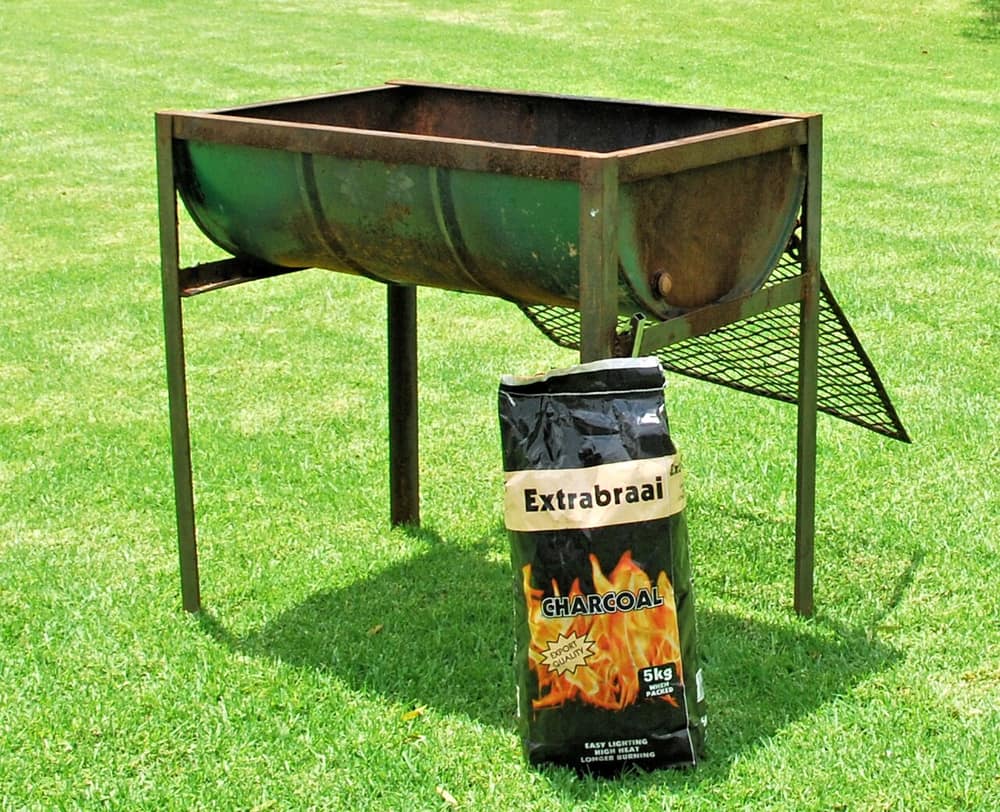
The classic South African braai stand: a steel drum cut lengthways, mounted on a frame, with a grid on top. Many have a lid hinged to the other half of the drum. They take wood or charcoal, hold a big fire and are usually at the entry-level end of the price range.
Best for: traditional wood braais, large groups, tight budgets.
Free-standing box braai stands
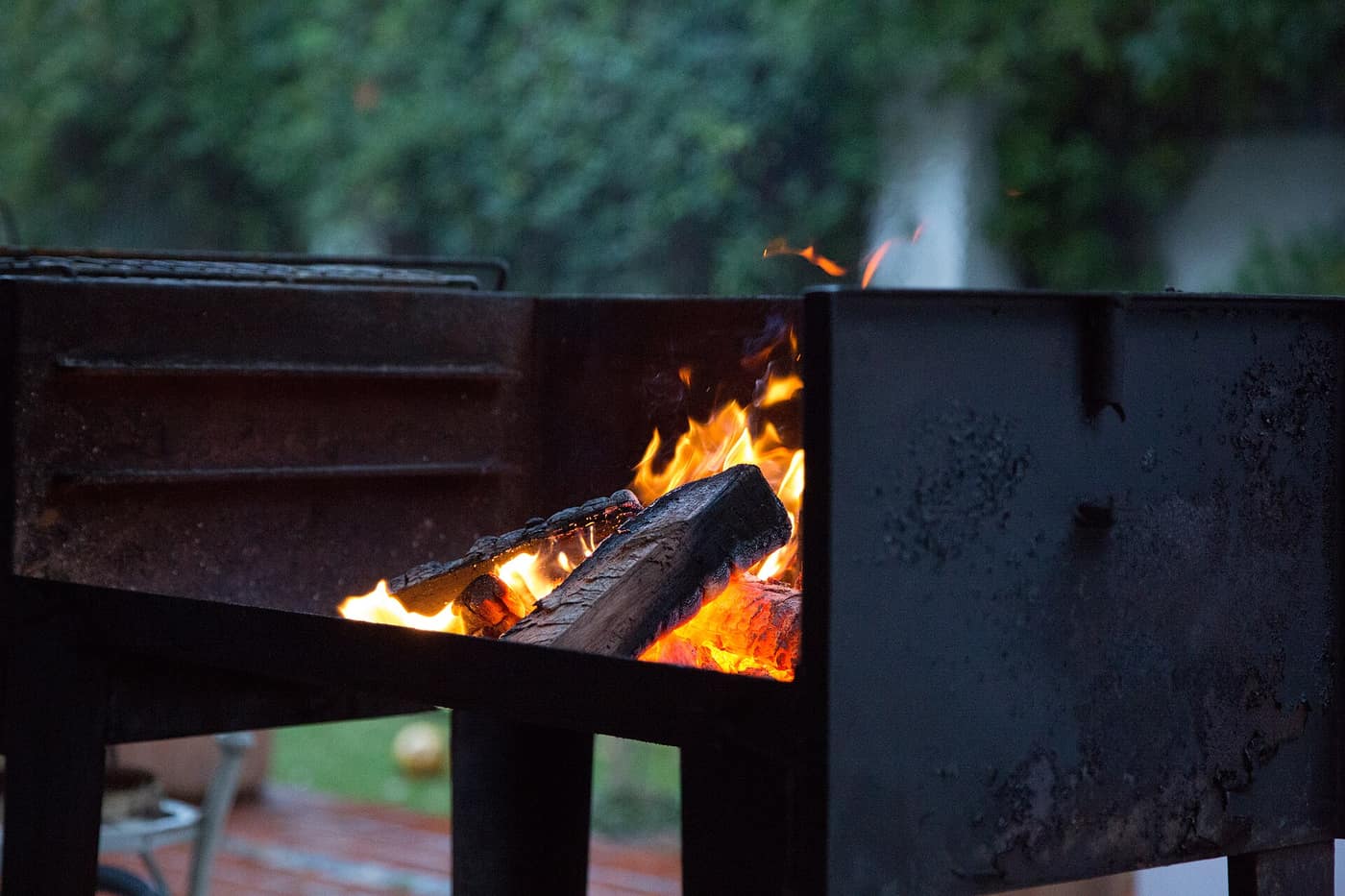
A rectangular steel firebox on legs, often with a fire grate to burn wood on one side and rake coals to the other. Better models add a height-adjustable grid, an ash tray, wheels, and side shelves or a wood rack underneath. Some trolley braais include an “ember maker”, a basket that burns wood and drops fresh coals below it.
Best for: people who braai with wood most weekends and want more control than a drum gives.
Kettle braai stands
A round charcoal braai with a domed lid and vents. With the lid closed you can cook indirectly, so it roasts, bakes and smokes as well as braais. Kettles are designed for charcoal and briquettes, not big wood fires.
Best for: one braai that does almost everything; smaller patios. See our Weber braai guide for the best-known kettle range, and our guide to smoking meat on a braai for what the lid makes possible.
Tripod and fold-up braai stands
Light, folding stands and tripods (often with a hanging grid or a potjie hook) for camping, the beach and picnics. They pack small but are less stable and less durable than a home braai.
Best for: travel and occasional use, or as a second braai. A tripod is also the easiest way to hang a pot over the fire; our potjiekos guide covers the rest, and the camping braai guide covers stands, skottels and campsite fire rules.
Built-in braai inserts
A steel firebox designed to be built into brickwork. It isn’t strictly a “stand”, but many people compare the two when planning a patio. If you want something permanent, read our built-in braai guide.
Braai stand types compared
| Type | Fuel | Lid | Portability | Price band | Best for |
|---|---|---|---|---|---|
| Drum / half-drum | Wood or charcoal | Often | Heavy, movable | Entry-level | Big wood fires, big groups |
| Free-standing box | Wood or charcoal | Sometimes | Heavy, movable | Entry to mid-range | Regular wood braais |
| Kettle | Charcoal / briquettes | Yes | Movable on wheels | Entry to premium | Versatile cooking, roasts |
| Tripod / fold-up | Wood or charcoal | No | Very portable | Entry-level | Camping, beach |
| Built-in insert | Wood or charcoal | No (cowl/chimney) | Fixed | Mid-range to premium | Permanent patios |
Materials: what your braai stand is made of
- Mild steel is the most common and cheapest. It works well but rusts once paint burns off, so it needs a cover and occasional repainting with heat-resistant paint.
- Stainless steel resists rust far better, which matters at the coast. Thicker gauges last longer; very thin stainless can warp in a hot wood fire.
- Enamelled (porcelain-coated) steel is used on kettles. It resists rust and cleans easily but can chip if knocked.
- Cast iron grates and grids hold heat well and give strong grill marks, but need oiling to prevent rust.
Thickness matters more than the label. A heavy firebox in mild steel can outlast a thin stainless one, especially if you braai with wood.
Steel thickness: reading the spec sheet
South African braai listings usually give the sheet steel in millimetres. If you see a gauge number instead, remember it runs backwards: the higher the number, the thinner the steel. On the common steel gauge charts, 16 gauge is roughly 1.5 mm and 11 gauge roughly 3 mm. These figures from retailer and dealer listings show the spread:
| Steel listed | Example | What it suits |
|---|---|---|
| 0.45–0.7 mm mild steel (listings differ) | Metalix Large Braai Stand 401, a flat-pack budget stand | Occasional charcoal braais; expect a short life over hot wood fires |
| 1.2–1.6 mm steel | Fireside portable fire pit and braai models at Outdoor Warehouse | Camping and light use, where low weight matters |
| 1.5 mm 430 stainless | Technipunch Safari Big Boy portable braai | Portable stainless that resists rust better than thin mild steel |
| 3 mm hot-rolled mild steel | HomeFires fireboxes, according to dealer GC Fires (304 stainless or 3CR12 to special order) | Regular wood fires at home |
Two things to check before you trust a number:
- Which part it describes. A listing may give the grid bars, the body or the firebox. The firebox floor takes the most heat, so that’s the figure to ask for.
- What the steel is. Mild steel needs paint or a cover to stay rust-free. 3CR12 is a South African-developed 12% chromium utility stainless steel; it resists corrosion better than mild steel but less well than 304, so it isn’t a coastal-grade substitute.
Size: how big should your braai stand be?
Think in grid size and how many people you usually feed:
- Two to four people: a small kettle or compact box stand is enough.
- Four to eight people: a standard-size kettle or a mid-size box or drum stand.
- Eight or more: a full drum, a large box stand, or two braais running together.
With wood, you need room to keep a fire going on one side while you cook over coals on the other. That means a wood braai needs a bigger firebox than the grid alone suggests. Working out the menu too? The braai meat calculator tells you how much meat to buy per person.
What to look for: a buying checklist
- Stability. Push on the stand. It should not wobble when loaded with a hot fire and a full grid.
- Steel thickness and welds. Look for solid welds and steel that doesn’t flex when you press it.
- Adjustable grid height. A grid you can raise or lower gives you real heat control, especially with wood.
- Ash handling. A removable ash tray or catcher saves a lot of mess.
- Air flow. Vents or gaps under the fire grate help the fire burn well and the coals form evenly.
- Working height. You shouldn’t have to stoop over the grid. Check the height in store if you can.
- Shelves and storage. A side shelf for the meat tray and a rack for wood are worth having.
- Wheels. Useful for moving a heavy stand out of the rain; look for wheels that lock or sit opposite fixed feet.
- Spares. Replacement grids and grates should be easy to find.
- Rules. Check body corporate or estate rules before buying a wood or charcoal stand for a complex or balcony.
Braai stands worth buying
These are in stock at South African retailers as we write, from a camping tripod to a full family trolley. Prices change, so check the store before you buy.

Megamaster
Megamaster Foldable Braai Tripod
The simplest braai stand there is: a folding tripod that holds a potjie or a grid over an open fire. Throw it in the bakkie for weekends away.
- Foldable tripod
- Takes a potjie or a grid
- Packs flat for travel
- Pocket-money price
- You still need a safe fire spot underneath
- Not a replacement for a home braai

Megamaster
Ember Series 37cm Kettle Braai
A compact charcoal kettle with a lid, so you can braai direct or cook with the lid down. A sensible size for a couple or a small patio.
- 37cm kettle
- Enamel-coated
- Hinged cooking grate
- Charcoal / briquettes
- Lid opens up indirect cooking
- Small footprint
- Too small for a crowd
- Made for charcoal, not a wood fire

HomeFires
HomeFires Light Trolley 700 Braai
A proper wood-and-charcoal box braai on wheels with a work surface, ash pan and potjie hook. Everything a family braai needs without spending big.
- Mild steel
- 820 × 505 × 880 mm
- 680 × 480 mm grid
- 25 kg, with wheels
- Ash pan and potjie hook included
- Light enough to wheel under cover
- Mild steel needs a cover to stay rust-free
- Lighter build than the big trolleys

HomeFires
Homefires 1200 Trolley Braai
A long, heavy trolley braai with two grids and an ember maker, so you can keep a fire going on one side and cook on the other. Built for the whole family.
- Mild steel
- 1580 × 480 × 1150 mm
- 2 × 500 × 460 mm grids
- Ember maker, poker and potjie hook
- Ember maker keeps fresh coals coming
- Room for two lots of meat at once
- 62.6 kg: it won't move far
- Needs a big patio
Prices change often; check the retailer for the current price and stock. We may earn a commission if you buy through these links, at no extra cost to you. Star ratings are the store's own customer reviews, shown once a product has at least 3. How we choose products.
What a braai stand costs in South Africa
The type of stand sets the starting price, but steel, size and built-in extras decide where you end up. These in-stock examples from South African retailers show roughly where each band starts.
| Type | Example in stock | Price (Nov 2026) | What the money gets you |
|---|---|---|---|
| Tripod / fold-up | Megamaster Foldable Braai Tripod | around R199 at Megamaster | A frame for a potjie or grid; you supply a safe fire spot |
| Kettle | Megamaster Ember Series 37cm Kettle Braai | around R949 at Megamaster | Lid and vents for indirect cooking, sized for a small household |
| Light box trolley | HomeFires Light Trolley 700 | around R3,879 at Braai Culture | Mild-steel box on wheels with ash pan, potjie hook and work surface |
| Portable stainless | HomeFires 430 S/S Bakkie Braai | around R5,699 at Braai Culture | Compact stainless braai that comes with a carry bag |
| Table / counter stand | HomeFires 800 Table/Counter with Ash Lid | around R5,999 at Braai Culture | Freestanding table braai with an ash lid and a 15-year guarantee against heat damage |
| Heavy trolley | HomeFires 800 Trolley Braai | around R8,499 at Braai Culture | Ember maker and poker on a bigger, heavier frame |
| Premium freestanding | Jetmaster Cabinet 850 Freestanding Braai | around R12,799 at Braai Culture | Cabinet-style braai for a dedicated spot on the patio |
We couldn’t find drum or half-drum stands in stock at the retailers we track, but they remain the usual entry-level way to get a big fire, and local welders often make them to order.
What the extra money buys
- An ember maker. The Light Trolley 700 has a 680 × 480 mm grid. The dearer 800 Trolley has a smaller 550 × 460 mm grid on a longer frame, with the extra length going to the ember maker. You’re paying for a steady supply of fresh coals, not more grid space.
- Stainless steel. The HomeFires Camp Braai is around R8,559 in mild steel and around R19,329 in stainless at Braai Culture (Nov 2026). Same design, more than double the price.
Where to buy a braai stand in South Africa
Hardware stores such as Builders, general retailers like Makro and Game, Takealot, camping stores and specialist braai shops all sell stands, and local welders make drum and box stands to order. If you can, see one in person: weight, steel thickness and welds are hard to judge from a photo.
Where to put your braai stand
A good stand in the wrong spot is still a fire risk. Before the first fire, pick its permanent home with these in mind:
- Clear space around it. Manufacturers set their own minimum distance from anything that can burn, and it varies. Weber’s charcoal braai manuals give anything from 60 cm to 1.5 m depending on the model, so read the manual for yours. Many fire-safety sources suggest about 3 m from the house as a cautious rule of thumb.
- Nothing overhead. Kettle manuals warn against using them under overhead combustible construction, and that’s sensible for any open fire: no wooden pergolas, shade cloth, low eaves or thatch above the stand.
- Never indoors or in a garage. Burning charcoal and wood give off carbon monoxide. Kettle manuals rule out garages, buildings and any other enclosed area, so keep the stand in the open air.
- A non-combustible base. Weber’s manuals count wooden decks as combustible material, so the clearance rule applies to the deck under the stand too. Paving, concrete or gravel is the safer surface for a stand that drops ash and embers.
- Level, sheltered ground. A stand on a slope can tip when you lean on it. Check where the wind usually blows from, so smoke and sparks drift away from the house, the washing line and the neighbours.
If you want a dedicated fire spot rather than a stand on the stoep, our guide on how to build a boma covers siting a permanent outdoor fire area.
Buy or build your own?
Many South Africans build their own braai stand from an old drum or steel plate. Building makes sense if you can weld, have the materials and want a custom size. A few cautions:
- Never use a drum that held fuel, chemicals or anything toxic. Residues can be dangerous when heated. Use a new or food-safe drum, or buy one sold for braai building.
- Avoid galvanised steel for anything that touches the fire. The zinc coating gives off harmful fumes when it gets very hot.
- Use heat-resistant paint only on the outside, and burn the braai in properly before cooking on it.
If you are not handy with a welder, a ready-made stand is usually better value once you count materials and time.
Care and common problems
How long a stand lasts depends on the steel, how often you braai and how you look after it, and many that die young rust out from the bottom up. The fire burns the paint off the firebox floor, ash collects there, and rain does the rest. A short routine after each braai prevents most of it:
- Empty the ash once it’s completely cold, every time. Wood ash mixed with water turns strongly alkaline and attacks bare steel, so don’t leave a firebox full of ash out through a rainy week.
- Brush the grid while it’s still warm, then oil it lightly.
- Cover the stand once it’s cold, and keep it under a roof if you can.
- Check legs, wheels and welds each season for cracks or loose bolts.
Braai stand problems and how to fix them
| Problem | Likely cause | What to do |
|---|---|---|
| Fire smoulders, coals take ages | Ash blocking air under the fire grate, or damp wood | Clear the ash, open any vents and burn dry hardwood |
| Meat charred outside, raw inside | Grid too low over coals that are too hot | Raise the grid a notch or rake some coals aside, then check with the hand test |
| Coals run out before the meat is done | No feeder fire, or a firebox too small for one | Keep a small fire going on one side and rake fresh coals across |
| Stand rocks when you turn the grid | Uneven paving or loose bolts | Move it to level ground and tighten every bolt |
| Paint blistering inside the firebox | Direct flame burns paint off | Leave the inside bare; touch up the outside only |
| Rust holes in the firebox floor | Wet ash sitting in the bottom | If only the fire grate or ash pan has rusted through, replace it if spares exist; a holed firebox floor is often the end of a cheap stand |
| Grid sagging or rods working loose | Thin rods softened by hot fires | Replace the grid; our braai grid guide covers what to buy |
When you touch up rust, wire-brush the spot and paint the outside only. High-heat paint is made for hot surfaces, not direct flame, and some brands warn against using it inside a grill. Some also only reach full strength once they’ve been heat-cured, so follow the drying and curing steps on the tin before the next fire. For a proper deep clean of the grid, firebox and ash pan, follow our step-by-step guide on how to clean a braai.
Whatever stand you choose, keep a fire blanket or small extinguisher nearby, and never leave a fire unattended. Good fuel makes a difference too: our braai wood guide covers which woods give the best coals, and the firelighters guide explains which ones light easily without leaving a paraffin taste on the meat.
FAQ
What is the best type of braai stand?
There’s no single best type. A free-standing box or drum stand suits wood braais and big groups, while a kettle suits charcoal and gives you more cooking options with the lid. If you’re torn, our guide to choosing a braai walks through the trade-offs.
How thick should the steel be on a braai stand?
There’s no official minimum, but about 3 mm is a useful benchmark for a firebox that takes wood fires most weekends: dealer GC Fires lists HomeFires fireboxes, for example, as 3 mm mild steel. Sheet of 1.5 mm or less suits camping and occasional charcoal braais better than weekly wood fires. Stainless resists rust better than mild steel, which matters at the coast, but a thick, covered mild-steel firebox can outlast thin stainless.
Can I use wood in a kettle braai?
Kettles are designed for charcoal and briquettes. A small amount of wood chunks for smoke flavour is fine, but a full wood fire can get too hot and damage the finish. For wood, choose a drum or box stand.
How high should the grid be above the coals?
There’s no fixed number. Some South African braai recipes put the grid roughly 5–15 cm over very hot coals for quick cuts and 15–20 cm over moderate coals, which is why an adjustable grid is worth paying for. Go by heat rather than a ruler: with your palm about 10 cm above the grid, steak wants coals you can only bear for 2–3 seconds, wors 4–5 (see how to braai steak and how to braai boerewors).
Can I use a braai stand on a balcony?
Only if your body corporate rules allow it, and only with enough clearance from walls, awnings and anything flammable. Many complexes ban wood and charcoal on balconies, in which case a gas braai is often the permitted option.
Do I need a braai stand with a lid?
Not for a traditional wood braai, where you cook over open coals and keep a feeder fire going beside them. A lid earns its place if you braai with charcoal and want to roast, bake or smoke, because closing it lets you cook with indirect heat, much like an oven.
What’s the difference between 304 and 430 stainless steel on a braai?
Grade 304 contains roughly 8% to 10.5% nickel, which helps it resist rust and pitting much better than 430, a cheaper grade with little or no nickel. Near the sea, 430 tends to show surface rust sooner. You pay for the difference: Braai Culture lists the Jetmaster Entertainer 700 built-in at around R13,499 in 430 and around R18,699 in 304 coastal grade (Nov 2026).

Johan Botha
Braai & outdoor editor
Writes our braai, fire pit and pizza oven guides. Firmly in the wood-fire camp, but owns up to a gas braai for weeknights.
More from Johan →