We're independent: products are chosen on merit and prices come from the retailers' own sites. We may earn a commission if you buy through our links. Learn more.
Key takeaways
- A radiant (panel) cabinet heater with a 9 kg cylinder is the best all-round choice for a South African lounge or open-plan room.
- Never buy an indoor gas heater without an oxygen depletion sensor (ODS) and a flame-failure device; a tip-over switch is a bonus worth having.
- Running cost is simple maths: consumption in kg per hour × what you pay per kg of LPG. At R380 for a 9 kg refill, that's about R42 a kg.
- Size to the room, not the coldest night: respect the manufacturer's minimum room size and run on fewer panels once the room is warm.
- Gas heaters keep working in load shedding, but never in a bedroom, never while you sleep and never without some fresh air coming in.
When the first cold front rolls in and the hardware stores stack gas heaters by the door, it’s tempting to grab whichever one is on promotion. But the wrong heater is either too weak for the room or too strong to use safely in it, and one without the right safety features is a real risk in a closed-up house.
A gas heater gives instant heat and keeps working through load shedding. This guide compares the types, sizing, running costs and the safety features you should never compromise on, then covers lighting and troubleshooting.
The short answer
| If you want… | Choose | Why |
|---|---|---|
| Fast, direct warmth in a lounge or open-plan room | Radiant (infrared panel) cabinet heater with a 9 kg cylinder | Feels warm within minutes; turn panels on and off to match the night |
| Gentler, more even heat in a closed-in living area | Blue flame (convection) heater | Warms the air, so the whole room evens out |
| Low, steady background heat | Catalytic heater | Quiet and mild, no visible flame |
| Warmth on the stoep or patio | Patio heater, and only outdoors | Built for open air; see our patio heater guide |
| Heat in a bedroom or overnight | Not gas. An electric oil heater | No flame, no fumes; see oil heater vs gas heater |
Whatever you buy, insist on an oxygen depletion sensor (ODS), a flame-failure device and, ideally, a tip-over switch, and never run it while you sleep.
Gas heater types compared
| Type | How it heats | Best for | Heat feel | Indoor use? |
|---|---|---|---|---|
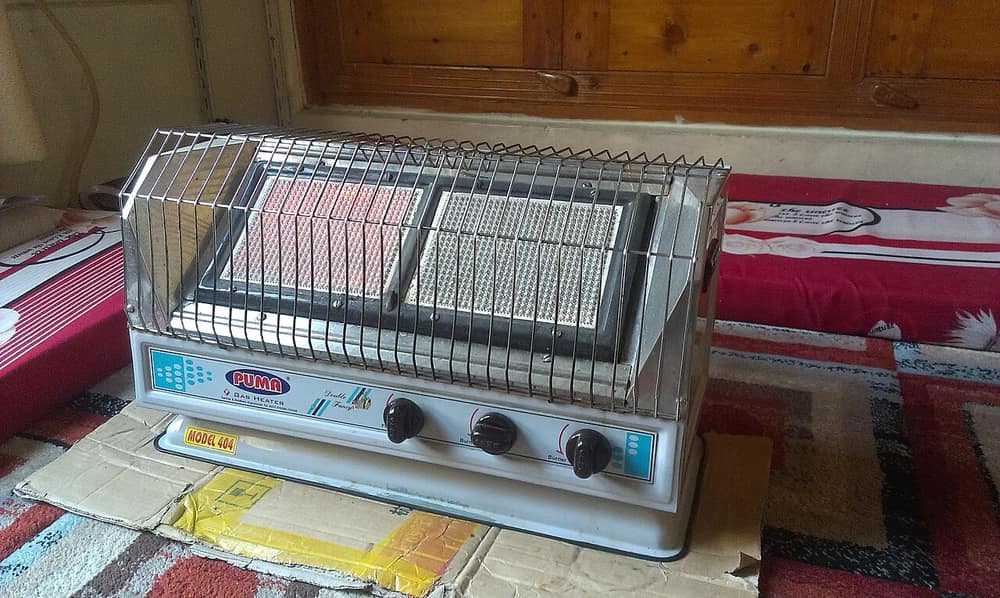
| Radiant / infrared panel (cabinet) | Ceramic panels glow and radiate heat at people and surfaces | Lounges, open-plan rooms, quick warmth | Fast, direct, “sun on your face” | Yes, if indoor-rated and ventilated |
| Blue flame (convection) | A burner heats air that circulates through the room | Closed-in living areas that need even warmth | Gentler, spreads further | Yes, if indoor-rated and ventilated |
| Catalytic | Gas reacts on a catalytic pad without an open flame | Steady background heat, smaller spaces | Mild, even | Yes, if indoor-rated and ventilated |
| Flued gas heater or fireplace | Combustion gases go out through a flue | Permanent heating of a main living area | Even, room-filling | Yes, installed by a registered gas installer |
| Patio / mushroom / pyramid | Burner at the top or in a glass tube radiates down and outward | Patios, stoeps, restaurants | Direct, outdoor | Never: built for open air, far too much heat for a closed room |
| Cylinder-top / “camping” heater | Small radiant head screwed onto a small cylinder | Outdoor use, camping | Very local | Check the manual: many are outdoor only |
Radiant (infrared panel) heaters
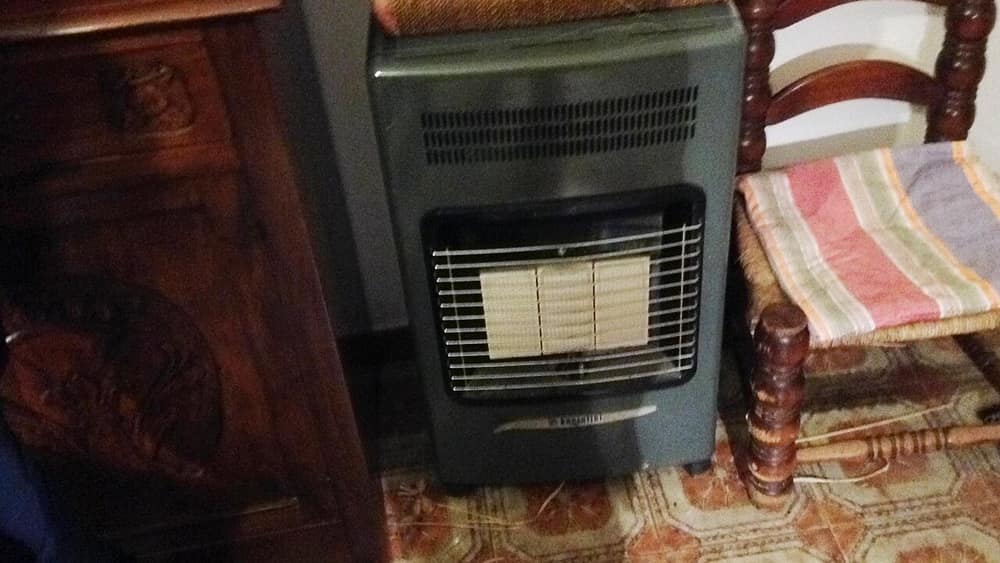
The classic South African gas heater: a cabinet on wheels with one to three ceramic panels and a 9 kg cylinder in the back. Run one panel on a mild Durban evening and all three on a frosty Highveld night. Radiant heat warms you rather than the air, so you feel it almost immediately, but it fades with distance. Point it at the couch, not the middle of the room.
Blue flame (convection) heaters
Blue flame heaters warm the air, which then circulates, so an enclosed room evens out and nobody roasts while someone else shivers. The trade-off: they’re slower to feel warm, and the heat escapes quickly through open doors and big sliding windows.
Catalytic heaters
Sizing a gas heater for your room
Gas heaters are rated in kilowatts (kW). More kW means more heat, but also more gas and more oxygen used, so bigger isn’t automatically better.
- Measure the room. Floor area (length × width) and, with high ceilings, volume (× height). Manufacturers state a maximum heating area or a minimum room volume.
- Check the minimum room size. If your room is smaller than the manual’s minimum, the heater isn’t suitable, no matter how cold it is.
- Think about your house. A Highveld home with single glazing, tiled floors and high ceilings loses heat far faster than a well-insulated coastal flat.
- Use the settings. One or two panels is often enough once the room has warmed up.
Our heater size calculator suggests a size from your room’s dimensions and estimates LPG versus electric running costs.
If you want to heat several rooms or the whole house, a portable gas heater isn’t the right tool. Look at a closed combustion fireplace or a flued gas fireplace instead.
Safety features to insist on
Every indoor gas heater burns oxygen and produces combustion gases, including water vapour, carbon dioxide and, if anything goes wrong, carbon monoxide (CO). These features are your first line of defence:
| Feature | What it does | Must-have? |
|---|---|---|
| Oxygen depletion sensor (ODS) | Shuts off the gas if the oxygen level in the room drops | Yes. Don’t buy an indoor gas heater without one |
| Flame-failure device | Cuts the gas if the flame or pilot goes out, so unburnt gas isn’t released | Yes |
| Tip-over (anti-tilt) switch | Shuts the heater off if it’s knocked over | Strongly recommended; not every model has one, so check |
| Piezo ignition | Lights the heater with a button, so no matches near the gas | Nice to have |
| Sturdy guard and stable base | Keeps hands, pets and fabric off the panels | Essential with children and pets |
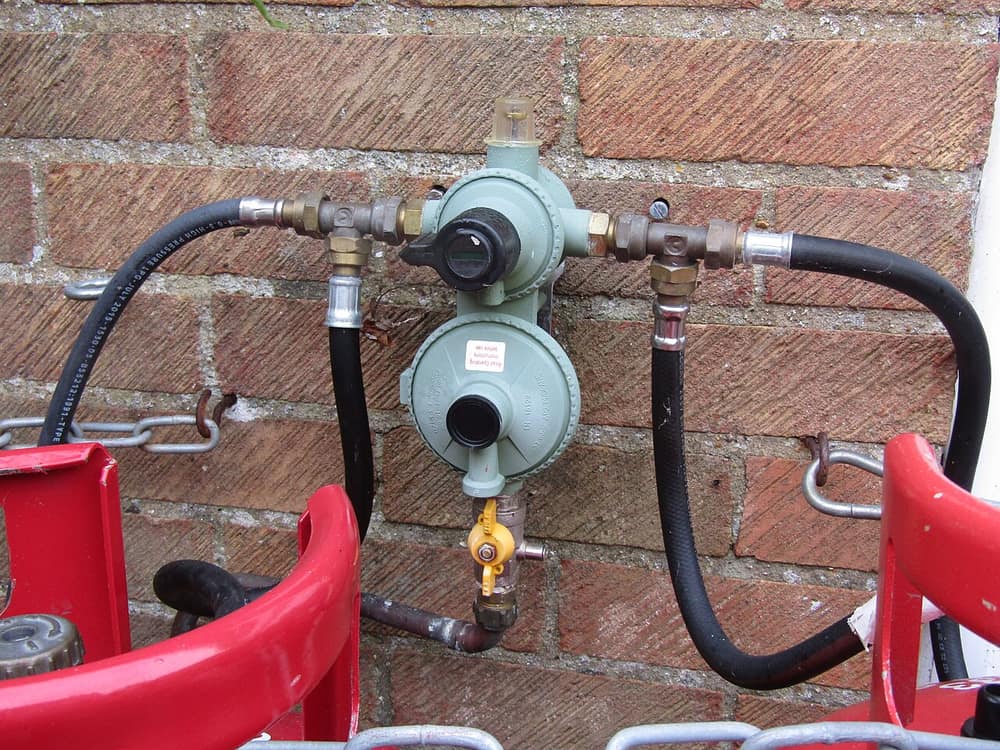
| Correct regulator and hose | Delivers gas at the right pressure | Yes. Replace hoses that are cracked, stiff or past their date |
Safety features are a backstop, not a licence to close up the room. Read our full gas heater safety guide before winter, and fit a carbon monoxide alarm in any room where you use gas (see smoke and CO detectors).
The non-negotiables
- Keep a window or door slightly open while the heater is on.
- Never leave a gas heater on while you sleep, and never use one in a bedroom, bathroom or small closed room.
- Keep it at least a metre from curtains, couches, washing and anything else that can burn, unless the manual gives a larger distance.
- Do a soapy-water leak test every time you connect a cylinder.
- Switch off at the cylinder valve when you’re done, not just at the heater.
Cylinders: 9 kg, 19 kg or 48 kg?
Portable cabinet heaters take a 9 kg LPG cylinder inside the cabinet. The 19 kg and 48 kg sizes are for fixed installations such as gas fireplaces, hobs and geysers, where the cylinder stands outside and gas is piped in.
Keep cylinders upright and store spares outside in a shaded, ventilated spot, never in a cupboard or below ground level: LPG is heavier than air and pools in low places. Our gas cylinder safety guide covers storing, moving and changing cylinders step by step.
Running costs: how to work them out
LPG prices vary by region and dealer, so work it out yourself in two steps.
1. Find the gas consumption in g/h or kg/h at each setting, in the manual or on the rating plate. If you only have the kW rating, estimate: LPG contains roughly 13 to 14 kWh of energy per kg, so a heater burning at 4 kW uses roughly 0.3 kg per hour on full.
2. Multiply by your gas price.
Cost per hour = consumption (kg/h) × price per kg
Price per kg is your refill price divided by the cylinder size.
A worked example
Alva sells a 9 kg refill voucher for R380 (Gauteng only, Nov 2026). Here’s what that means for a heater burning about 0.3 kg an hour on full:
| Step | Sum | Result |
|---|---|---|
| Price per kg | R380 ÷ 9 kg | about R42 per kg |
| Cost per hour on full | 0.3 kg/h × R42 | about R12.70 an hour |
| Hours per cylinder on full | 9 kg ÷ 0.3 kg/h | around 30 hours |
Swap in your own refill price and your heater’s real consumption figure, or let the gas cylinder calculator do the sums.
Gas vs electric
Compare the cost of a kilowatt-hour of heat: R42 per kg divided by about 13.5 kWh per kg gives roughly R3.10 per kWh of heat from gas. If your electricity tariff is noticeably lower, electric heat is cheaper, and vice versa. Our oil heater vs gas heater guide has the full comparison, including load shedding.
Our picks
Indoor heaters and one essential spare. Prices change often, so check the live price.

ALVA
3-Panel Luxurious Infrared Radiant Indoor Gas Heater
The classic three-panel radiant cabinet heater that most South African lounges run on. Three panels give you a big range, from a gentle glow to full blast on a Highveld night.
- Three ceramic infrared panels
- Separate burner chambers
- Up to 50 m² (maker's claim)
- Fast, direct radiant warmth
- Good value for a full-size three-panel heater
- Large cabinet to find a spot for
- Heat fades the further you sit from it

ALVA
Blue-Flame Convection Roll-About Gas Heater - Black
A blue flame convection heater warms the air rather than whoever is sitting in front of it, so the whole room evens out. Better for a closed-in living area than a draughty open plan.
- Blue flame convection
- Roll-about cabinet on wheels
- Matte black finish
- More even warmth across the room
- The visible flame is easy to check at a glance
- Slower to feel warm than a radiant heater
- Heat escapes fast through open doors

ALVA
Single Panel Indoor Gas Heater Small
A small single-panel heater for a study corner, a large well-ventilated kitchen or a weekend away. It comes with the two safety features that matter most.
- Single radiant panel
- Rear-mounted cylinder
- ODS and flame-failure protection
- Compact and easy to move
- ODS and flame failure included
- One panel won't warm a big open-plan room

ALVA
Infrared Radiant Gas & Electric Dual Indoor Heater
Runs on gas or electricity, so you can use the plug when the power is on and switch to the cylinder when it isn't. Handy if your electricity tariff and gas price are close.
- Gas or electric operation
- Infrared radiant heat
- Up to 50 m² (maker's claim)
- Two fuel options in one appliance
- Keeps heating through outages on gas
- Costs more than a gas-only cabinet heater

ALVA
Bullnose Gas Regulator & 1.2m Hose Kit
A perished hose is one of the easiest gas risks to fix. Check that this regulator matches your cylinder valve and heater before you swap it in.
- For 9 kg cylinders with bullnose valve
- Low-pressure regulator, 1.2 m hose, 2 clamps
- SANS 1237 & SANS 1156 approved
- Cheap insurance against a cracked hose
- Everything in one pack
- Only fits bullnose (5/8" BSP) valves
Prices change often; check the retailer for the current price and stock. We may earn a commission if you buy through these links, at no extra cost to you. Star ratings are the store's own customer reviews, shown once a product has at least 3. How we choose products.
Brands and where to buy
Alva, Cadac, Goldair and Megamaster gas heaters are sold locally alongside many house brands, at hardware chains, camping stores, gas dealers and online. Ranges change every winter, so compare the model’s safety features, kW rating and minimum room size rather than the brand name, and look for an LPGSA approval listing. Rough price bands:
- Entry: single-panel and basic cabinet heaters, such as Alva’s single-panel heater at around R1,199 (Nov 2026). Check that an ODS and flame-failure device are included.
- Mid: three-panel radiant or blue flame cabinet heaters, often with a tip-over switch: around R1,299 for Alva’s three-panel and R1,699 for its blue flame model (Nov 2026).
- Premium: flued gas heaters and gas fireplaces, which need professional installation.
Installation: portable vs fixed
A portable cabinet heater needs no installer. A fixed installation does: if gas is piped from cylinders outside into a heater or fireplace, the work must be done by a gas installer registered with SAQCC Gas, who issues a Certificate of Conformity (CoC) when the job is done. Insurers can refuse claims for gas installations without one, and you’ll need a valid CoC when you sell the house. Read our gas compliance certificate guide, or get quotes from registered gas installers.
Lighting it, and what to do when it misbehaves
Follow your manual first. On most ODS cabinet heaters the sequence is:
- Connect the regulator, open the cylinder valve and do a soapy-water leak test before you light anything.
- Turn the control knob to the pilot position, press it in and click the piezo button until the pilot lights.
- Hold the knob in for as long as the manual says (often 30 seconds to a minute) so the flame-failure thermocouple heats up and keeps the gas valve open. Then release it and light the panels.
- First use or a fresh cylinder can need a longer hold while air bleeds out of the hose. If the pilot won’t light or stay lit, turn the knob off and wait the time your manual gives (often five minutes) so any unburnt gas clears before you try again.
| Problem | Likely cause | What to do |
|---|---|---|
| Pilot dies when you release the knob | Thermocouple not hot yet, or air in the hose | Hold longer, and wait the manual’s time between tries. If it never stays lit, have it serviced |
| Switches itself off after a while | ODS sensing too little fresh air, a draught on the pilot, a nearly empty cylinder or a dirty pilot | Air the room before relighting, then open the window wider, move it out of the draught and check the cylinder. If it keeps tripping, have it serviced. Never bypass the ODS |
| Yellow, lazy or sooty flame, soot above the heater | Poor combustion | Switch off and have it serviced before using it again |
| Smell of gas | Leak at the valve, regulator or hose | No flames or switches. Close the cylinder valve if safe, open up and get out; if the smell persists, call your gas supplier or emergency services from outside. Don’t use it until fixed |
| Headache, dizziness or nausea while it runs | Possible carbon monoxide | Turn it off at the cylinder if safe, get everyone into fresh air and get medical help. Don’t use it again until it has been checked |
Before winter, check the hose and regulator for cracks, dust the panels and leak test. Off-season, disconnect the cylinder and store the heater upright somewhere dry.
FAQ
Are indoor gas heaters safe?
They can be, when you use a heater rated for indoor use with an ODS and flame-failure device, keep the room ventilated, keep it away from anything flammable and never leave it on while you sleep. A carbon monoxide alarm adds an important extra layer.
How long does a 9 kg gas cylinder last in a heater?
Divide 9 kg by the heater’s consumption in kg per hour. At about 0.3 kg an hour on full, that’s roughly 30 hours, and longer on lower settings.
How much does it cost to run a gas heater?
At R380 for a 9 kg refill (about R42 a kg), a heater using 0.3 kg an hour costs roughly R12.70 an hour on full.
Can I use a gas heater during load shedding?
Yes. Portable gas heaters don’t need electricity. The usual rules still apply: ventilation, no sleeping with it on, and a leak test after every cylinder change.
Can I use a patio heater inside?
No. Patio heaters are built for open air only. Indoors they can quickly use up oxygen and build up carbon monoxide, and their heat output is a fire risk in an enclosed space.

Lize van Wyk
Heating & fireplaces writer
Covers gas heaters, fireplaces and keeping a South African home warm through winter and load shedding.
More from Lize →