We're independent: products are chosen on merit and prices come from the retailers' own sites. We may earn a commission if you buy through our links. Learn more.
Key takeaways
- Layer, don't stir: meat at the bottom, slow vegetables in the middle, quick vegetables on top.
- Brown the meat first over hotter coals, then cook gently on just a few coals for at least two to three hours.
- Use little liquid. The vegetables release their own moisture, and too much turns a potjie into soup.
- A number 3 potjie suits a family meal for around six people; bigger groups need a number 4 or larger.
- Season a new pot before its first use, and dry and oil it after every use to stop rust.
Potjiekos is slow food in the best sense: a three-legged cast-iron pot, a few coals and a few hours with friends around the fire. It’s also forgiving, as long as you respect three rules: layer it, keep the heat low and leave the lid alone.
This guide covers choosing and seasoning a potjie, the golden rules, how many coals to use, three classic recipes with full quantities, and the mistakes that turn a good potjie into stew or soup.
At a glance
| Pot | Round, three-legged cast iron. A number 3 feeds around six; go bigger for more |
| Heat | Hotter coals to brown the meat, then just a few coals for a gentle simmer |
| Time | At least 2–3 hours; 4 hours or more for oxtail or shank |
| Liquid | Very little. Vegetables add their own moisture |
| The rule | Layer, don’t stir. Keep the lid on |
Choosing a potjie
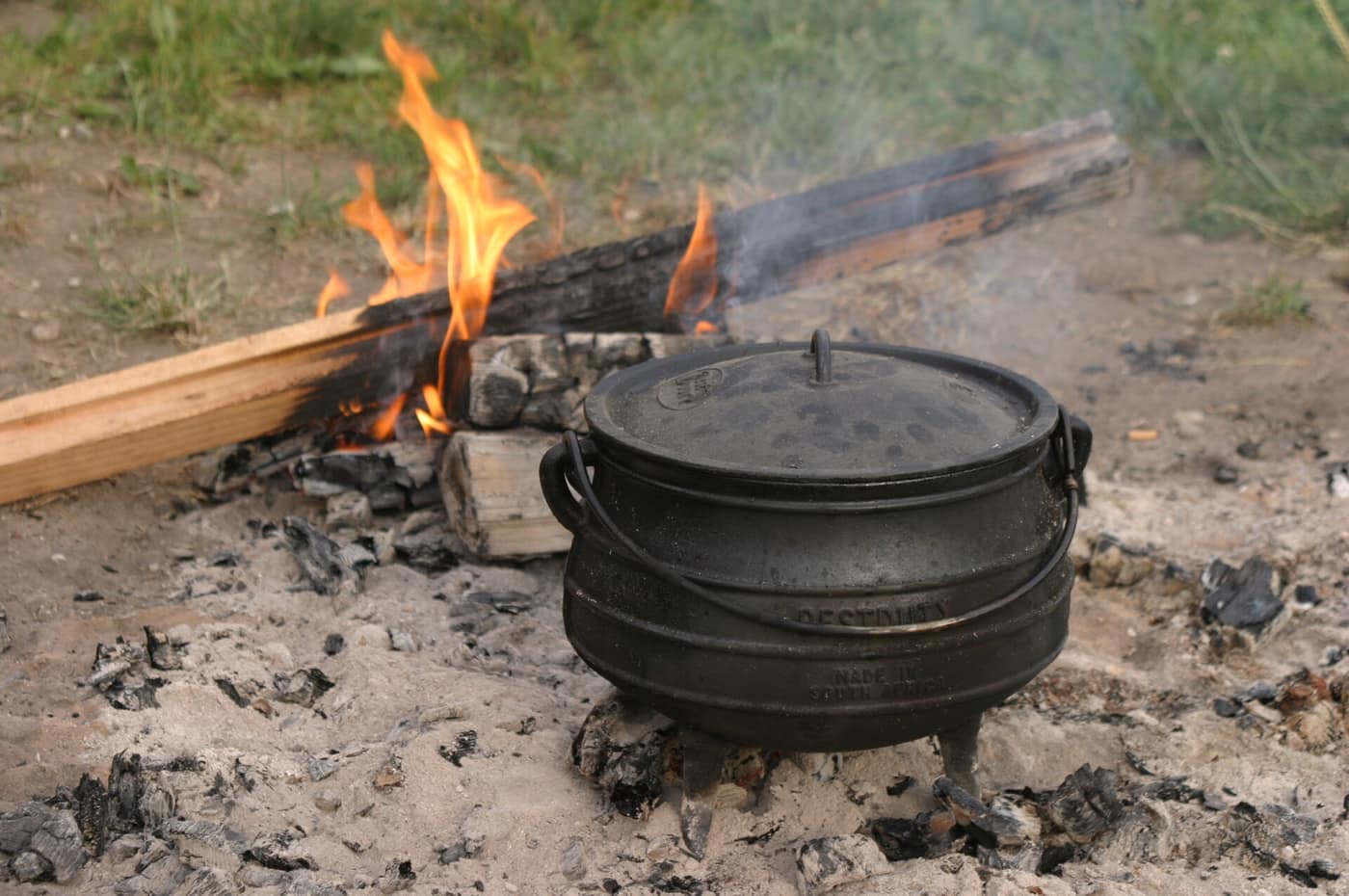
The traditional round, three-legged pot is used for potjiekos. The legs let it stand directly over a small bed of coals. Flat-bottomed potjies are better for baking potbrood and for use on a stove.
Potjies come in numbered sizes. The bigger the number, the bigger the pot. As a rough guide, a number 3 suits a family meal for around six people, while bigger gatherings call for a number 4 or larger. Check the manufacturer’s capacity for the exact size; the Megamaster No.3 Pro, for example, is listed at 10.8 litres.
Seasoning a new potjie
New cast-iron pots often come with a protective coating, and all cast iron needs seasoning to prevent rust and sticking.
- Wash the pot well with hot, soapy water and a scourer to remove the factory coating. Rinse and dry it completely.
- Rub a thin layer of cooking oil over the inside and the lid.
- Heat the pot over coals or on the stove until the oil smokes and darkens, then let it cool.
- Repeat a few times. Some people also cook a batch of vegetable scraps in it first and throw them away.
After every use, wash it with hot water (little or no soap), dry it over heat and wipe it with a thin layer of oil before storing it. Our guide to cast iron cooking on the fire covers rust removal and how a potjie compares with a flat pot and a skillet.
The golden rules of potjiekos
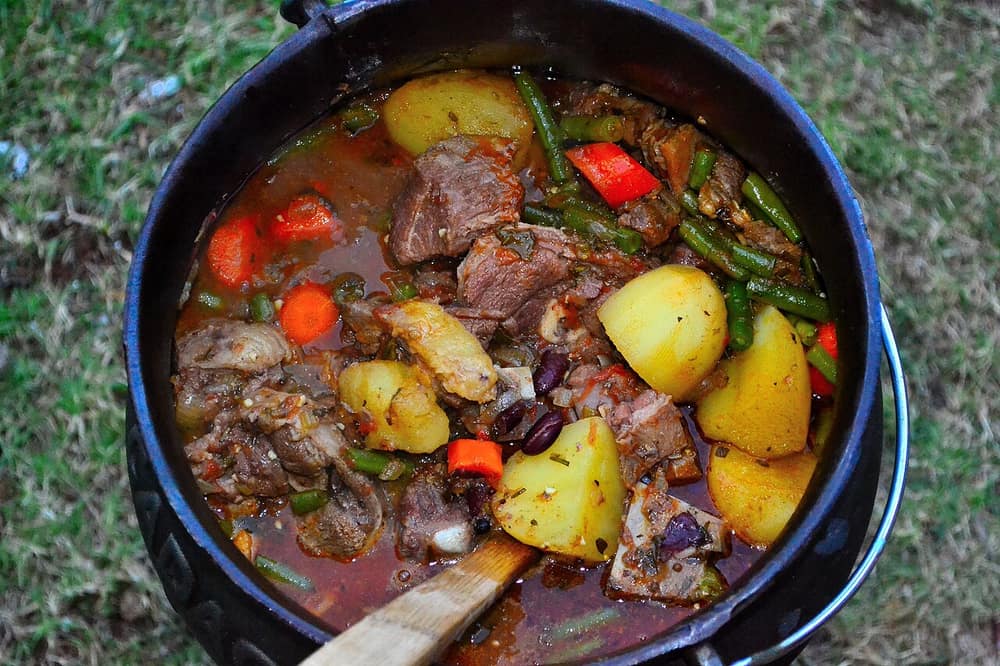
- Layer it, don’t stir it. Meat goes at the bottom, then the vegetables that take longest (potatoes, carrots, butternut), then quicker vegetables (baby marrows, green beans, mushrooms) on top. Stirring turns it into stew.
- Brown the meat first. Fry the meat and onions in the pot over hotter coals before you add the layers.
- Use little liquid. The vegetables release their own moisture. Too much liquid boils the food instead of steaming it.
- Low heat, long time. Once it’s layered, it should simmer gently. Most potjies need at least two to three hours, longer for tougher cuts like oxtail or shank.
- Keep the lid on. Every time you lift it you lose heat and moisture.
How many coals?
Far fewer than you think. After browning, a few coals (or a small bed of coals) under the pot is usually enough to keep a gentle simmer. Listen to the pot: a soft bubbling sound is right; loud spitting means it’s too hot.
Keep a small fire going on the side so you can add a coal or two as needed. Our guide on how to make a braai fire explains the side-fire method, and dense woods like sekelbos and mopane from our braai wood guide give the long-lasting coals a potjie needs.
Recipe 1: classic lamb potjie (serves 6, No. 3 pot)
Ingredients
- 30 ml oil
- 1.5 kg lamb neck or knuckles
- 2 onions, chopped
- 3 cloves garlic, crushed
- 250 ml red wine (or beef stock)
- 2 bay leaves, salt and pepper
- 8 medium potatoes, peeled and halved
- 4 carrots, cut into chunks
- 300 g green beans, trimmed
- 250 g mushrooms, halved
Method
- Heat the oil in the pot over hot coals. Brown the lamb in batches, then add the onions and garlic and fry until soft.
- Add the wine, bay leaves and seasoning. Pull most of the coals out, leaving just a few, put the lid on and simmer for about 1.5 hours.
- Layer the potatoes and carrots on top of the meat, then the green beans and mushrooms. Don’t stir.
- Lid on, simmer gently for another hour or so, until a knife slides through the potatoes. Check once or twice that it isn’t boiling dry; add a splash of liquid only if needed.
Recipe 2: chicken potjie with cream (serves 6, No. 3 pot)
Ingredients
- 30 ml oil
- 1.5 kg chicken thighs and drumsticks
- 2 onions, chopped
- 2 cloves garlic, crushed
- 125 ml chicken stock
- 1 tsp dried thyme, salt and pepper
- 600 g baby potatoes
- 2 carrots, sliced
- 250 g mushrooms
- 250 ml cream
Method
- Brown the chicken in the oil over hot coals. Add the onions and garlic and fry until soft.
- Add the stock, thyme and seasoning. Layer the potatoes and carrots, then the mushrooms.
- Reduce to a few coals, lid on, and simmer for about 1.5 hours, until the potatoes are tender and the chicken is cooked through (74°C in the thickest part).
- Pour the cream over the top for the last 10 minutes.
Recipe 3: oxtail potjie (serves 6, No. 3 or 4 pot)
Slow, rich and worth the wait. Plan on four hours or more.
Ingredients
- 30 ml oil
- 2 kg oxtail
- 2 onions, chopped
- 3 cloves garlic, crushed
- 1 tin (410 g) chopped tomatoes
- 250 ml red wine (or beef stock)
- 2 bay leaves, 1 tsp dried thyme, salt and pepper
- 6 potatoes, halved
- 4 carrots, in chunks
- 250 g button mushrooms
Method
- Brown the oxtail well in the oil over hot coals, in batches. Add the onions and garlic and fry until soft.
- Add the tomatoes, wine, herbs and seasoning. Reduce to a few coals, lid on, and simmer for about 3 hours, until the meat is starting to come off the bone. Check now and then that there’s still some liquid at the bottom.
- Layer the potatoes and carrots, then the mushrooms. Simmer for another hour or so, until the vegetables are tender.
More classic combinations
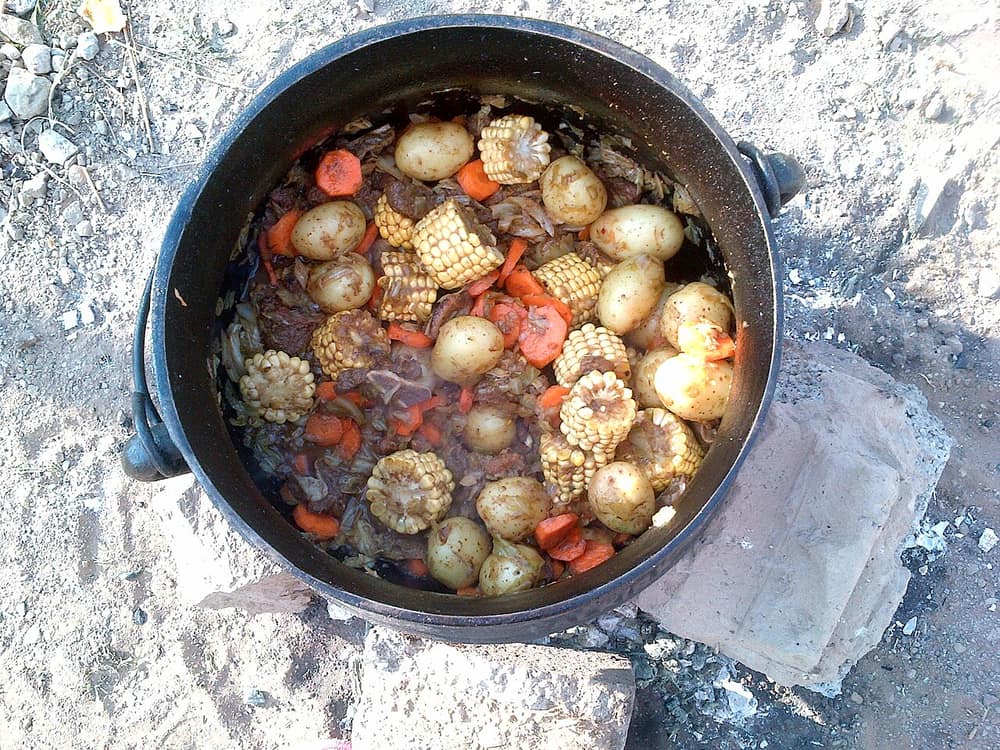
- Lamb or mutton potjie: neck or knuckles, potatoes, carrots, green beans, with a little red wine.
- Oxtail potjie: slow, rich and worth the wait. Plan four hours or more.
- Chicken potjie: thighs and drumsticks, mushrooms, baby potatoes, cream added at the end.
- Vegetable potjie: butternut, sweet potato, chickpeas, curry spices.
Serve with pap, rice or potbrood, and one fresh side from our braai salads. A potjie served early also stretches the meat at a big braai; see how much braai meat per person.
What to buy
A number 3 is the right first potjie for most families. Add a bread pot if you want potbrood, and a gas burner for days when you can’t (or don’t want to) make a fire.

Megamaster
Megamaster No.3 Pro Potjie
The family-size number 3, with screw-in legs so it also sits on a gas burner or stove, and a lid that doubles as a pan. The carry bag is a bonus for weekends away.
- No. 3
- 10.8 L capacity
- Cast iron, screw-in legs
- Dual-purpose lid, carry bag
- Works on coals, gas and stove tops
- Legs come off for easier storage
- Cast iron is heavy, especially when full

Megamaster
Megamaster No 4 Potjie
A traditional three-legged number 4 for bigger gatherings, when a number 3 won't stretch far enough.
- No. 4
- Cast iron
- Three cast-iron legs
- Fitted lid
- Room for a crowd
- Classic round-bottomed potjie shape
- Needs more coals and more space on the fire
- Heavy to lift when full

Megamaster
Megamaster Bread Pot
A cast-iron bread pot with a raised lid, so you can heap coals on top and bake potbrood next to the potjie.
- Cast iron
- Raised lid for coals on top
- Even heat for baking
- Good value next to a potjie
- A bread pot, not a stew pot; you'll still need a potjie

ALVA
Alva Potjie Cooker Top - Gas Burner for 3kg & 5kg LPG Cylinders
A burner that screws onto a 3 kg or 5 kg LPG cylinder. Handy when you can't make a fire, and it gives the low, steady heat a potjie wants.
- Fits 3 kg and 5 kg LPG cylinders
- 210 g/hr gas consumption
- Compact and lightweight
- Controllable low heat
- Cheap way to cook a potjie without a fire
- No wood-fire flavour
- Use it outdoors, with the cylinder upright
Prices change often; check the retailer for the current price and stock. We may earn a commission if you buy through these links, at no extra cost to you. Star ratings are the store's own customer reviews, shown once a product has at least 3. How we choose products.
Common mistakes
- Fire too hot: the bottom burns before the top is cooked.
- Too much water: you end up with soup.
- Stirring: the layers break down into mush.
- Lifting the lid: you lose heat and moisture every time.
- Rushing: potjiekos can’t be hurried. Start early.
Cooking for a crowd outdoors? Keep a hose or fire extinguisher handy, and never leave the fire unattended.
FAQ
What size potjie do I need?
A number 3 suits a family meal for around six people. For bigger gatherings, go for a number 4 or larger, and check the manufacturer’s listed capacity. The potjie size calculator works out the size from the number of people you’re feeding.
How long does potjiekos take?
At least two to three hours for most potjies, and four hours or more for tough cuts like oxtail or shank.
Should you stir potjiekos?
No. Layer the ingredients (meat at the bottom, slow vegetables next, quick vegetables on top) and leave them. Stirring breaks down the layers into stew.
How much liquid goes in a potjie?
Very little, often just a cup or so of wine or stock. The vegetables release their own moisture. Add a splash more only if the bottom is in danger of boiling dry.
How do I stop my potjie from rusting?
After every use, wash it with hot water, dry it over heat and wipe it with a thin layer of oil before storing it. Re-season it if rust appears.

Johan Botha
Braai & outdoor editor
Writes our braai, fire pit and pizza oven guides. Firmly in the wood-fire camp, but owns up to a gas braai for weeknights.
More from Johan →